 Aleksandra Koszela, Product & CX Strategist at Flownally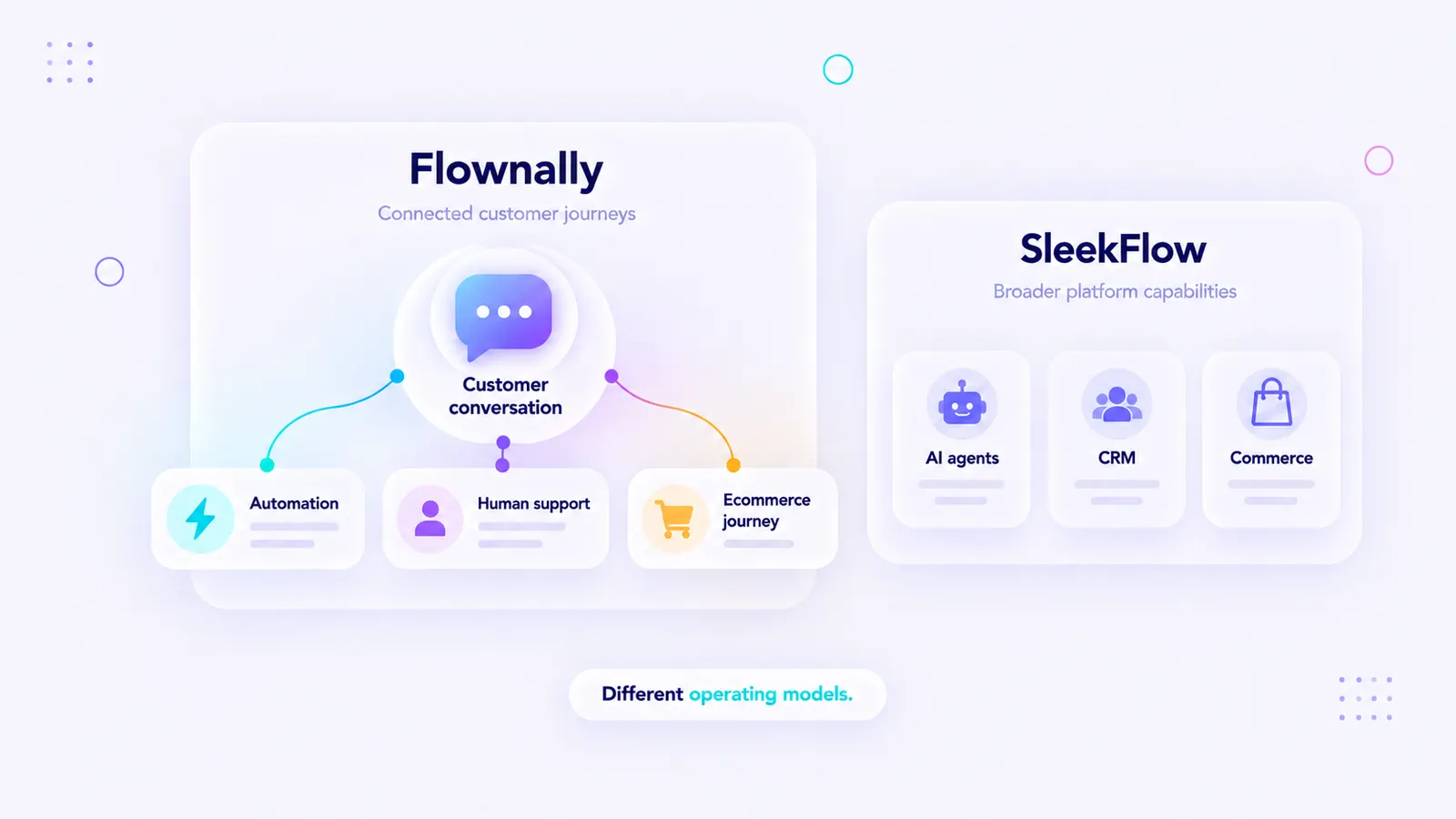
Flownally vs SleekFlow for Ecommerce: 2026 Comparison
Flownally is the stronger fit for ecommerce teams that want customer conversations, automation, WhatsApp campaigns, human support, and ecommerce events to work as one connected journey.
SleekFlow may fit better when broader messaging-channel coverage, autonomous AI agents, or native Shopify and payment capabilities are the priority.
Flownally can become the central workspace for customer communication and connect with ecommerce systems as the business needs it. SleekFlow brings more AI, CRM, channel, and native commerce functionality directly into its own platform.
- Flownally is built around connected customer conversations. Inbox activity, chatbots, journeys, human replies, ecommerce events, campaigns, and later follow-ups can work around the same customer context.
- You don't need a complex technology stack to start. Flownally can centralize channels and automate repetitive communication first, then connect more ecommerce data and external systems as the business grows.
- SleekFlow offers broader channel coverage. It supports additional channels such as LINE, WeChat, TikTok, Telegram, Viber, email (beta), and live chat.
- SleekFlow has a more extensive autonomous AI layer. AgentFlow is designed to handle sales and support tasks through AI agents.
- Their commerce approach differs. SleekFlow brings more native Shopify, payment, CRM, and commerce functionality into its platform. Flownally keeps customer communication at the center and can connect it with external commerce systems when needed.
- Both support outbound communication. Flownally combines targeted WhatsApp marketing campaigns with customer context, journeys, replies, and human conversations.
- The better fit depends on what you want messaging to manage. Flownally is particularly strong when conversation continuity, automation, human support, and lifecycle communication matter. SleekFlow becomes more attractive when native commerce breadth, autonomous AI, or additional regional channels are priorities.
Why this comparison matters for ecommerce teams
Flownally and SleekFlow solve many of the same ecommerce messaging problems. Both can centralize customer conversations, automate messaging, use customer data, support outbound communication, and move conversations from automation to people.
The difference becomes clearer when you ask a broader question:
How much should your messaging platform manage?
Flownally brings customer conversations, automation, journeys, campaigns, and human support into one communication environment. Teams can start by organizing messaging and automating repeatable interactions, then connect customer communication with ecommerce events and external systems as their needs grow.
SleekFlow takes a broader platform approach, combining messaging with autonomous AI agents, CRM functionality, native Shopify capabilities, payments, and a wider channel portfolio.
That distinction matters because messaging is increasingly part of the buying experience.
Meta and Kantar's 2026 State of Business Messaging research, based on 11,056 consumers across 22 markets, found that 73.3% prefer messaging when communicating with a business, while 72.4% are more likely to purchase from a brand that offers messaging.
The harder problem is making customer conversations work together rather than creating another disconnected channel.
Infobip's 2026 Customer Experience Maturity Report found that while 96% of surveyed brands automate customer interactions in some way, only 58% say their channels are fully in sync, and just 27% use an orchestration platform.
Customers notice fragmentation too. SAP's 2026 Engagement Index research found that 82% of surveyed UK consumers are put off by disorganized interactions that require them to repeat information or be passed between teams.
For ecommerce teams, the messaging platform affects more than response speed. It influences how easily customer intent, automation, people, campaigns, purchase events, and later buying moments can work together.
Flownally vs SleekFlow: side-by-side comparison
Last updated: October 2026
| Category | Flownally | SleekFlow |
|---|---|---|
| Best fit | Ecommerce teams that want customer conversations, automation, human support, campaigns, and lifecycle journeys connected in one communication system | Teams looking for broad messaging coverage, autonomous AI agents, native commerce capabilities, CRM functionality, and enterprise tooling |
| Core channels | WhatsApp, Instagram, Messenger, SMS | WhatsApp, Instagram, Messenger, SMS, TikTok, Telegram, LINE, WeChat, Viber, live chat, and others |
| Shared inbox | Yes, with customer, chatbot, journey, automation, and team messages visible together | Yes, with customer data, assignments, collaboration, AI, and CRM functionality |
| Automation | Visual Journey Builder plus chatbot automation, conditions, waits, events, and HTTP requests | Flow Builder plus AI-agent workflows |
| AI | Intent Detection for understanding and routing conversations, combined with configurable chatbots and journeys | AgentFlow AI agents for sales and support |
| Human handoff | Chatbot-to-human routing with previous conversation context available | AI-to-human escalation and team conversation management |
| Customer data | Customer profiles, tags, custom fields, activity, and conversation history | CRM data, customer properties, segmentation, and conversation history |
| Ecommerce connectivity | APIs, HTTP requests, custom events, and external triggers when deeper system connectivity is needed | Native Shopify functionality plus integrations, APIs, and webhooks |
| Native commerce | Customer communication and journey management, with external commerce systems connected as needed | Shopify sync, catalogs, payments, payment tracking, and commerce workflows |
| Marketing campaigns | Targeted WhatsApp campaigns with segmentation, personalization, scheduling, replies, and reporting | Broadcast campaigns connected with messaging, CRM data, automation, and analytics |
| Lifecycle communication | Pre-purchase conversations, post-purchase journeys, campaigns, follow-ups, reorder reminders, and reactivation | Automation, campaigns, CRM, and ecommerce workflows |
| Pricing model | All features included on every plan. Plans scale mainly by active contacts and support level; unlimited users are included | Plans based partly on monthly active contacts, users, and plan allowances |
| Product approach | One connected customer communication system that can integrate deeper as the business grows | Broad conversational commerce platform with AI and native commerce capabilities |
For a more feature-focused overview, see the Flownally vs SleekFlow comparison page.
The core difference: how much should your messaging platform manage?
Flownally can become the central workspace for customer communication. A smaller ecommerce team might start with:
WhatsApp + Instagram + shared inbox + automated answers + human handoff
That already removes a large amount of messaging chaos.
As the operation becomes more sophisticated, the same setup can grow into:
customer conversations + journeys + campaigns + ecommerce events + APIs + external systems
Teams don't have to build a complicated integration architecture before Flownally becomes useful. The platform can centralize communication first and connect more data as those requirements appear.
The current Flownally Features page shows how inbox, customer profiles, journeys, chatbots, human handoff, campaigns, and integrations work around the same customer conversation.
SleekFlow brings more commerce functionality directly into its own environment. Its ecommerce offering includes native Shopify integration, product and order data, product catalogs, automated order notifications, abandoned-cart workflows, payments, CRM functionality, automation, and AI agents. See SleekFlow's ecommerce solution for its current native commerce capabilities.
The choice comes down to the role you want the platform to play.
Flownally can sit at the center of customer communication and connect with the wider business as needed. SleekFlow extends further into the commerce and AI layer itself.
Where Flownally is particularly strong
Flownally becomes especially relevant when ecommerce teams want customer communication to feel like one continuous journey rather than a collection of separate automations, campaigns, and support interactions.
1. One place to run customer conversations
Messages from WhatsApp, Instagram, Messenger, and SMS can be managed from the same workspace. Customer information, chatbot activity, automated messages, and team replies remain connected with the conversation.
For a business currently switching between messaging apps, this can be the first reason to use Flownally. The setup doesn't need to begin with advanced integrations. You can centralize communication, automate the repetitive parts, and give the team one place to handle the conversations that still need people.
2. Event-based customer journeys
When the business needs deeper automation, journeys can respond to customer or ecommerce events.
For example:
order_created → start post-purchase journey
A journey can then:
- send a message,
- wait for a period, date, or event,
- split customers into different paths,
- update customer context,
- transfer the conversation to a team,
- send a campaign,
- or exchange information with another system.
This lets automation respond to what the customer is actually doing.
3. Conversation continuity
A customer interaction can move from automation to a person without losing the earlier context.
For example:
Customer asks a question → Intent Detection identifies the need → chatbot collects information → advisor joins
The advisor can see what happened earlier and continue from there. That matters especially when automation can handle the predictable part of the buying journey, but product advice, judgment, or exception handling still benefits from a person.
4. Customer communication can grow with the business
Flownally doesn't require every ecommerce team to use the same level of technical connectivity.
A simpler operation may mainly need:
inbox + automation + chatbot + human handoff + campaigns
A more developed ecommerce setup can also use:
custom events + APIs + webhooks + HTTP requests
That lets customer communication become more closely connected with order data, lifecycle events, or other systems over time.
5. Lifecycle communication
The conversation can continue after the first purchase.
For example:
- 1Product question
- 2Chatbot
- 3Advisor
- 4Purchase
- 5Post-purchase journey
- 6Campaign
- 7Reorder reminder
This is where Flownally moves beyond inbox management. The same customer relationship can continue across sales, support, follow-up, and repeat-purchase moments.
For the wider strategy behind this model, see our guide to conversational commerce in ecommerce.
6. WhatsApp marketing campaigns connected with customer context
Flownally also supports targeted WhatsApp marketing campaigns.
Teams can use customer context to build audiences, personalize messages, schedule campaigns, track results, and continue customer replies in the shared inbox.
For example:
Customer buys → enters post-purchase journey → becomes eligible for a relevant campaign → replies → conversation continues
This makes campaigns another part of the customer relationship.
Potential use cases include:
- product launches,
- replenishment,
- repeat purchases,
- relevant promotions,
- product recommendations,
- post-purchase communication,
- and reactivation.
For ecommerce teams that use WhatsApp for both buying conversations and follow-up, this keeps inbound and outbound communication closer together.
Where SleekFlow is particularly strong
SleekFlow becomes particularly relevant when breadth inside the platform matters more.
Broader channel coverage
SleekFlow supports more channels overall. Its portfolio includes WhatsApp, Instagram, Messenger, SMS, TikTok Business Messaging, Telegram, LINE, WeChat, Viber, live chat, email (beta), and others. See the current SleekFlow Channels & Integrations.
This can be a meaningful advantage for businesses operating in markets where LINE, WeChat, or other regional platforms are central to customer communication.
Autonomous AI agents
SleekFlow has also invested heavily in AI agents.
AgentFlow is designed to automate sales and support interactions, use business information, complete tasks, and escalate conversations to people when needed. Human agents can receive context from the preceding AI interaction. See SleekFlow AgentFlow for its current AI capabilities.
For teams whose strategy depends heavily on autonomous AI handling a large share of customer conversations, this can be a strong advantage.
Native commerce functionality
SleekFlow also brings more commerce functionality directly into the platform. Its ecommerce solution includes Shopify data, product catalogs, abandoned-cart workflows, order communication, Stripe payments, payment tracking, and related commerce capabilities.
For teams that actively want messaging, AI, CRM, and native commerce capabilities to live close together, SleekFlow can be a good fit.
AI agents or structured automation with human control?
This is one of the clearest differences between the platforms.
Flownally currently uses AI selectively inside a more controlled automation model. Its Intent Detector can recognize what a customer is asking and send the conversation into the appropriate path.
Consider:
I need a moisturizer for very sensitive skin.
Flownally can identify product advice as the intent. Automation can collect basic information. A specialist can then take over with the previous conversation and customer context available.
This setup gives the ecommerce team clear control over what automation handles and where human judgment becomes useful.
That approach can work particularly well for products where consultation influences the buying decision. For more on this balance, see What Customer Messages Should Ecommerce Brands Automate First?
SleekFlow's AgentFlow puts more emphasis on autonomous AI agents that can independently handle sales and support tasks. If autonomous AI is central to your automation strategy, SleekFlow currently has the stronger offering.
If you want AI to help understand customer intent while keeping journey logic and human involvement more explicitly controlled, Flownally may be the stronger fit.
Do you actually need more messaging channels?
SleekFlow supports more channels overall. That matters if your customers actively use LINE, WeChat, TikTok Business Messaging, Telegram, Viber, or other platforms outside Flownally's current channel set.
Flownally focuses on WhatsApp, Instagram, Messenger, and SMS. Those channels work with its shared inbox, automation, journeys, customer context, campaigns, and human handoff. If those four channels cover the conversations your customers actually have with your business, raw channel count may not be the most useful comparison.
The questions that matter more are:
- What happens when someone messages you?
- Can automation use the context?
- Can a person step in smoothly?
- Can the conversation trigger a later journey?
- Can customer data influence the next campaign?
- Can an ecommerce event change what happens next?
If LINE, WeChat, or another additional messaging channel is essential to your operation, SleekFlow has the advantage.
How do marketing campaigns compare?
Flownally combines WhatsApp marketing campaigns with the same wider communication environment used for journeys and customer conversations. Teams can define audiences using customer information, personalize messages, schedule campaigns, track results, and continue replies inside the shared inbox.
For example:
Product question → human conversation → purchase → post-purchase journey → targeted WhatsApp campaign → customer reply
The campaign becomes another relevant customer moment.
This is useful for:
- product launches,
- replenishment,
- repeat purchases,
- reactivation,
- product recommendations,
- relevant promotions,
- and post-purchase communication.
SleekFlow also supports broadcast campaigns and connects them with its inbox, CRM, automation, and analytics. Its current Pro plan includes Broadcast Campaigns.
When comparing the two, look beyond the ability to send a broadcast.
Ask:
- Can customer context define the audience?
- Can the message be personalized?
- Can campaigns connect with other customer activity?
- Can a reply become a real conversation?
- Can the team understand what happened before the campaign?
The value of a campaign platform depends heavily on what happens after the send.
How does human handoff compare?
Flownally builds human handoff into the wider conversation model.
Automation can answer predictable questions, collect information, identify intent, and route the customer to the relevant team. The person who takes over can continue with the earlier conversation visible.
For example:
Do you have this ring in white gold?
may have a predictable answer.
But:
I'm choosing an anniversary gift between these two pieces. Which would you recommend?
may benefit from a human advisor.
Flownally is designed for that transition between structured automation and individual support.
SleekFlow also supports human escalation. AgentFlow can transfer AI-managed conversations to people while providing context from the earlier interaction.
Both platforms support human involvement. The more useful question is how much autonomy you want to give automation and how explicitly your team wants to control the moment where a person joins.
How does ecommerce integration compare?
Flownally can be useful before advanced ecommerce integration enters the picture. A team may start simply with messaging channels, inbox management, chatbot automation, journeys, and campaigns. When customer communication needs to respond to more business data, integrations can add another layer.
For example:
- order_created → send confirmation
- delivery_completed → start post-purchase flow
- customer status changes → choose another journey path
- external event arrives → continue journey
- customer replies → chatbot or human advisor
- another system needs data → HTTP request
This lets you make the messaging setup more sophisticated without changing the basic operating model.
If you want customer communication to work across the wider ecommerce journey, explore Flownally for Ecommerce.
SleekFlow has an advantage when native Shopify and commerce functionality inside the messaging platform is itself a major requirement. Its ecommerce solution can synchronize Shopify information and connect conversations with catalogs, cart recovery, payments, and other commerce workflows.
What about pricing?
The pricing models differ in an important way.
Flownally includes every product feature in every plan. Plans primarily scale with the number of active contacts and the level of support, while unlimited users are included across Starter, Professional, Ultimate, and Custom.
Current monthly pricing is:
- Starter — $19/month: up to 100 active contacts
- Professional — $199/month: up to 1,000 active contacts
- Ultimate — $499/month: up to 10,000 active contacts
- Custom — tailored pricing: custom active-contact volumes and support
Annual billing is 25% lower than the monthly price.
This means a smaller team can start with Flownally without moving to a higher plan just to unlock journeys, chatbots, campaigns, integrations, or other product features. As customer volume grows, the plan can scale with it.
See current Flownally pricing for the latest contact allowances, support levels, and additional-contact pricing.
SleekFlow structures its plans differently.
Its current Pro plan starts at $109/month when billed yearly with 500 monthly active contacts and 10 user accounts. Premium starts at $279/month when billed yearly with 1,000 monthly active contacts and 10 users. Some capabilities also depend on the plan: Premium adds features such as custom AI integrations, webhook integrations, additional CRM integrations, ticketing, role-based access control, and dedicated onboarding.
See current SleekFlow pricing for the latest limits and feature availability.
The headline subscription price therefore doesn't tell the whole story.
When comparing the two platforms, consider:
- how many active customers you expect to message,
- how many people need access,
- which product capabilities you need,
- how much automation you expect to run,
- your required support level,
- channel and WhatsApp fees,
- and how the cost changes as your customer volume grows.
For Flownally, moving between standard plans primarily increases scale and support rather than unlocking a different product.
For SleekFlow, both usage allowances and available capabilities can change between plan tiers.
Four ecommerce scenarios
Scenario 1: Growing ecommerce brand with complex buying conversations
A DTC brand receives questions through WhatsApp and Instagram.
Automation should answer repetitive questions. Product advisors should take over higher-intent conversations. After purchase, customers may enter post-purchase journeys, receive relevant campaigns, or return later through reorder communication.
The business wants those interactions to feel connected.
Flownally is likely the stronger fit.
Its inbox, automation, customer context, human handoff, journeys, and campaigns directly support this model.
See how Flownally works for ecommerce.
Scenario 2: Ecommerce team that wants one place to run customer conversations
The brand currently handles messages across Instagram, WhatsApp, Messenger, or SMS. People switch between tools. The same questions are answered repeatedly. The team wants one inbox, automated answers, customer journeys, human handoff, and campaigns.
Its current technical setup may be simple. Later, order data and other ecommerce events may need to influence those conversations.
Flownally is likely the stronger fit.
The team can start by centralizing and automating customer communication and connect more systems as the operation becomes more sophisticated.
Scenario 3: International retailer that depends on regional messaging channels
The retailer operates in markets where customers regularly use WhatsApp, Instagram, LINE, WeChat, TikTok, and other regional channels. The company wants those channels available inside one broader platform.
SleekFlow is likely the stronger fit.
Its wider channel portfolio directly addresses this requirement.
Scenario 4: Shopify retailer prioritizing autonomous AI and native commerce
A Shopify business wants autonomous AI agents to handle a large share of sales and support interactions. It also wants product catalogs, ecommerce data, payments, and other native commerce functionality close to messaging.
SleekFlow is likely the stronger fit.
AgentFlow and SleekFlow's native ecommerce capabilities align more directly with those priorities.
Which platform is better for ecommerce?
For ecommerce teams that want WhatsApp, Instagram, Messenger, and SMS conversations to become part of a connected buying journey, Flownally is likely the stronger fit.
You can start with one shared inbox and automation. Then add chatbots, human handoff, customer journeys, campaigns, ecommerce events, and deeper integrations as your communication operation grows.
Flownally can become the central workspace for customer communication without requiring the rest of the commerce operation to move into the same platform.
SleekFlow becomes more compelling when your requirements center on a broader international channel portfolio, autonomous AI agents, native Shopify capabilities, payments, or a wider CRM and commerce layer inside the messaging platform.
The strongest choice depends on the role you need customer messaging to play in your business.
Is Flownally a SleekFlow alternative?
Yes. Flownally overlaps with SleekFlow across customer messaging, automation, shared inbox management, customer context, human handoff, outbound campaigns, and business-system connectivity.
Flownally is particularly relevant for ecommerce teams that want customer conversations to move smoothly between automation, people, campaigns, and later lifecycle moments.
You can use it as the main workspace for customer communication and connect ecommerce systems when deeper data and event-based journeys become useful.
SleekFlow covers a broader set of channels and adds more autonomous AI, CRM, payment, and native commerce functionality inside the platform.
For ecommerce teams whose priority is connected customer communication, Flownally can be a particularly strong SleekFlow alternative.
See the detailed Flownally vs SleekFlow feature comparison.
How should you make the final decision?
Take one real customer journey.
For example:
- 1Instagram product question
- 2Automated response
- 3Human advice
- 4Purchase
- 5Post-purchase message
- 6Campaign
- 7Customer reply
- 8Repeat purchase
Then map that journey in both platforms.
Ask:
- Can the team manage the main customer channels in one place?
- Can repetitive conversations run automatically?
- Can a person step in without making the customer start again?
- Can customer information influence what happens next?
- Can an ecommerce event trigger or change a journey when needed?
- Can campaigns use the customer context already collected?
- What happens when someone replies to a campaign?
- Can the setup become more sophisticated as the business grows?
- Which additional features would we actually use?
- What will the full setup cost once users, contacts, automation, channels, campaigns, messaging fees, and integrations are included?
The answers usually reveal more than a raw feature count.
Comparing Flownally with other customer messaging platforms?
SleekFlow isn't the only platform ecommerce teams may compare with Flownally.
If your priority is social engagement automation, Instagram triggers, or comment-to-DM workflows, read our Flownally vs Manychat for Ecommerce comparison. If you're comparing customer messaging with a more traditional ecommerce helpdesk and support platform, see Flownally vs Gorgias.
You can also explore Flownally alternatives and comparisons to compare different approaches to messaging, automation, inbox management, and customer journeys.
Bring customer messages, automation, campaigns, human support, and follow-up journeys into one connected communication system.
Start simple. Connect more as your customer journey grows.



FAQ
Flownally focuses on connected customer communication across WhatsApp, Instagram, Messenger, and SMS. It combines a shared inbox, customer context, automated journeys, chatbots, intent detection, human handoff, WhatsApp campaigns, and integrations you can add as your business needs them.
SleekFlow combines messaging with broader channel coverage, autonomous AI agents, CRM functionality, native Shopify capabilities, payments, and additional commerce features.
Yes. Flownally is particularly relevant as a SleekFlow alternative for ecommerce teams that want conversations, automation, campaigns, human support, and lifecycle communication to work together.
It can centralize customer messaging on its own and connect with external ecommerce systems when deeper automation becomes useful.
See the detailed Flownally vs SleekFlow comparison.
No. Flownally can start as the central place for customer conversations across WhatsApp, Instagram, Messenger, and SMS.
Teams can use the shared inbox, automation, chatbots, customer context, human handoff, and campaigns without building a complex integration setup.
As the business grows, APIs, custom events, webhooks, and HTTP requests can connect customer communication with more ecommerce and operational data.
SleekFlow supports more messaging channels overall. Flownally focuses on WhatsApp, Instagram, Messenger, and SMS and connects those channels with automation, journeys, campaigns, customer context, and human handoff.
If those channels cover your customer communication, channel count alone may not be a meaningful differentiator. If LINE, WeChat, TikTok, Telegram, Viber, or other regional channels are essential, SleekFlow has the advantage.
The answer depends on what you want the messaging platform to do.
SleekFlow offers deeper native Shopify and commerce functionality inside its platform. Flownally can connect customer communication with ecommerce events and external systems while keeping messaging, journeys, campaigns, and human conversations together.
A Shopify business that wants native commerce capabilities inside the messaging platform may prefer SleekFlow. A business that wants customer communication to remain the central layer and connect with commerce data as needed may prefer Flownally.
Yes. Flownally includes an Intent Detector that identifies what a customer is asking and routes the conversation to the relevant path.
It combines intent recognition with configurable chatbot logic, customer journeys, and human handoff.
Yes. SleekFlow's AgentFlow provides autonomous AI agents for sales and customer support.
SleekFlow may fit better when autonomous AI is central to the communication strategy. Flownally may fit better when a team wants AI to help understand intent while keeping conversation paths and human involvement more explicitly controlled.
Yes. Flownally supports targeted WhatsApp campaigns alongside customer conversations and automated journeys.
Teams can segment audiences, personalize messages, schedule campaigns, track results, and continue replies in the shared inbox.
Yes. Flownally brings customer, chatbot, journey, campaign, and team activity into the same communication environment so conversations can continue with context.
SleekFlow also provides a shared inbox connected with its CRM, automation, AI, and customer data.
Both support human handoff.
Flownally is particularly well suited to journeys where automation handles predictable steps and a person joins when individual advice or judgment can improve the outcome. SleekFlow can also escalate conversations from AI agents to people.
The better fit depends on how autonomous you want automation to be and how you want your team to enter the conversation.
It depends on the channels your customers use.
Flownally supports WhatsApp, Instagram, Messenger, and SMS. If those channels cover your main markets and your priority is connecting conversations with automation, campaigns, customer journeys, and human support, Flownally can be a strong fit.
SleekFlow has the advantage when your international strategy requires additional channels such as LINE, WeChat, TikTok, Telegram, or Viber.
Flownally includes every product feature on every plan, with unlimited users. Plans primarily differ by active-contact volume and support level.
Current monthly pricing starts at $19/month for Starter with up to 100 active contacts, followed by Professional at $199/month with up to 1,000 active contacts and Ultimate at $499/month with up to 10,000 active contacts. Custom plans are available for larger volumes and custom requirements.
Annual billing is 25% lower.
Check current Flownally pricing for the latest details.
SleekFlow uses monthly active contacts alongside plan-specific user, automation, AI, and feature allowances. Its public pricing currently starts with Pro at $109/month when billed yearly.
Check current SleekFlow pricing for the latest limits and rates.
Yes. Flownally journeys can use messages, waits, conditions, customer context, events, and external systems to support order communication, post-purchase guidance, replenishment, reactivation, and repeat purchases.
A customer reply can also move the interaction back into automation or to a team member with the conversation context available.
Choose Flownally when your priority is turning customer conversations into connected journeys across messaging, automation, campaigns, and human support — with the flexibility to add deeper ecommerce integrations as you grow.
Consider SleekFlow when broader international channel coverage, autonomous AI agents, or more native commerce functionality inside the messaging platform are central requirements.