Shared team inbox
Manage WhatsApp, Instagram, Messenger, and SMS conversations in one workspace. Keep customer messages, chatbot activity, automated journey messages, and team replies visible in the same conversation history.
SleekFlow alternative for ecommerce
SleekFlow combines omnichannel messaging, AI agents, automation, ecommerce integrations, and team workflows in one platform.
Flownally brings WhatsApp, Instagram, Messenger, and SMS into one customer communication system — with a shared team inbox, customer profiles, no-code chatbots and journeys, AI intent detection, campaigns, human handoff, and API-connected ecommerce events.
The difference is how those capabilities work together across the buying journey — from the first product question to purchase, follow-up, and the next buying moment.
SleekFlow
Flownally
At a glance
Both platforms combine customer messaging, automation, team workflows, AI capabilities, and ecommerce integrations.
The difference is which capabilities your team needs — and how you want them to work together.
| Comparison | SleekFlow | Flownally |
|---|---|---|
| Best for | SleekFlowBusinesses looking for broad channel coverage, AI agents, native commerce and CRM integrations, and messaging workflows in one platform | FlownallyEcommerce teams that want messaging, automation, customer data, human conversations, campaigns, and follow-up journeys connected in one system |
| Messaging channels | SleekFlowWhatsApp, Instagram, Messenger, SMS, Telegram, plus channels such as LINE, WeChat, Viber, TikTok Business Messaging, and website live chat | FlownallyWhatsApp, Instagram, Messenger, and SMS managed in one customer communication workspace |
| Inbox & customer context | SleekFlowOmnichannel inbox with routing, customer data, collaboration, and AI-assisted workflows | FlownallyShared team inbox with customer messages, chatbot activity, automated journey messages, team replies, and customer context visible together |
| Automation & AI | SleekFlowFlow Builder plus AI Agents for automated sales and support workflows | FlownallyVisual Journey Builder and no-code Chatbot Builder with triggers, waits, conditions, events, HTTP requests, routing, and AI Intent Detection |
| Contacts & segmentation | SleekFlowContact data and segmentation connected with messaging channels and integrations | FlownallyContact import and management, tags, custom fields, filters, customer activity, conversation history, and audience building |
| Campaigns | SleekFlowBroadcast campaigns with segmentation and performance tracking | FlownallyTargeted WhatsApp campaigns with segmentation, personalization, scheduling, replies in the shared inbox, and reporting |
| Ecommerce & integrations | SleekFlowNative Shopify integration plus API and additional commerce and CRM integrations | FlownallyShopify and other ecommerce systems can connect through API, custom events, webhooks, and HTTP requests; external events can start or influence journeys |
| Best fit | SleekFlow“We want a broad omnichannel commerce and AI stack.” | Flownally“We want customer conversations, automation, campaigns, and lifecycle journeys to work as one system.” |
SleekFlow's native Shopify integration can sync customers, orders, and abandoned carts and make Shopify data available to its Inbox, Flow Builder, and AI Agent. Flownally connects external systems through API, custom events, webhooks and HTTP requests, so ecommerce activity can start or influence customer journeys.
Comparison reviewed in September 2026. Features and pricing may change.
Flownally connects the tools ecommerce teams use to manage customer conversations.
Manage WhatsApp, Instagram, Messenger, and SMS conversations in one workspace. Keep customer messages, chatbot activity, automated journey messages, and team replies visible in the same conversation history.
Import and manage contacts, add tags and custom fields, filter audiences, and keep customer information connected with previous conversations and activity.
Build no-code chatbot flows with quick replies, rich messages, conditions, and handoff. Intent Detector can understand what the customer is asking about and direct the conversation to the appropriate path.
Build journeys with triggers, messages, waits, follow-ups, conditions, tags, and customer or business events. Use HTTP requests when a journey needs to exchange information with another system.
Move conversations to the right person or team when automation is no longer enough — without making the customer start again.
Build audiences from customer data, send targeted WhatsApp campaigns, personalize and schedule messages, track results, and continue customer replies inside the same inbox.
Connect Shopify or another ecommerce system through API, custom events, webhooks, and HTTP requests.
Purchases, cart activity, profile changes, or other business events can start or influence what happens next.
All of these features can work perfectly separately, but they show their full potential when used in one continuous customer conversation.
Explore all Flownally featuresA customer message can determine what happens next.
Automation can choose the right path.
A person can step in with the existing context.
Customer activity can trigger the next follow-up.
The same customer journey connects all three.
Customer messages, profile data, conditions, external events, and detected intent can determine what happens next.
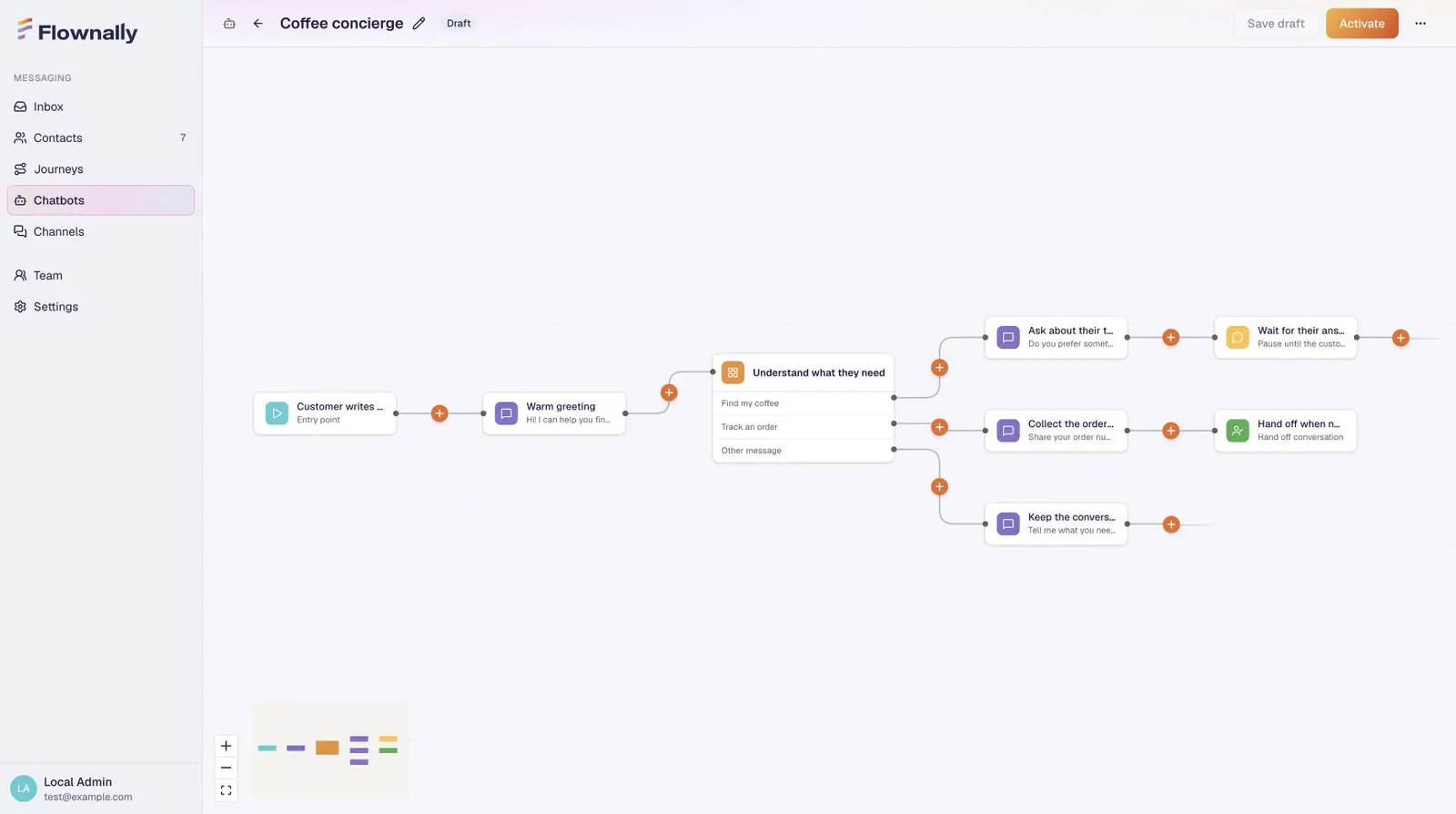
Customer message → Intent Detection → Journey path → Next action
When the customer needs individual advice, the team can continue from the existing conversation with customer context and previous automated steps visible.
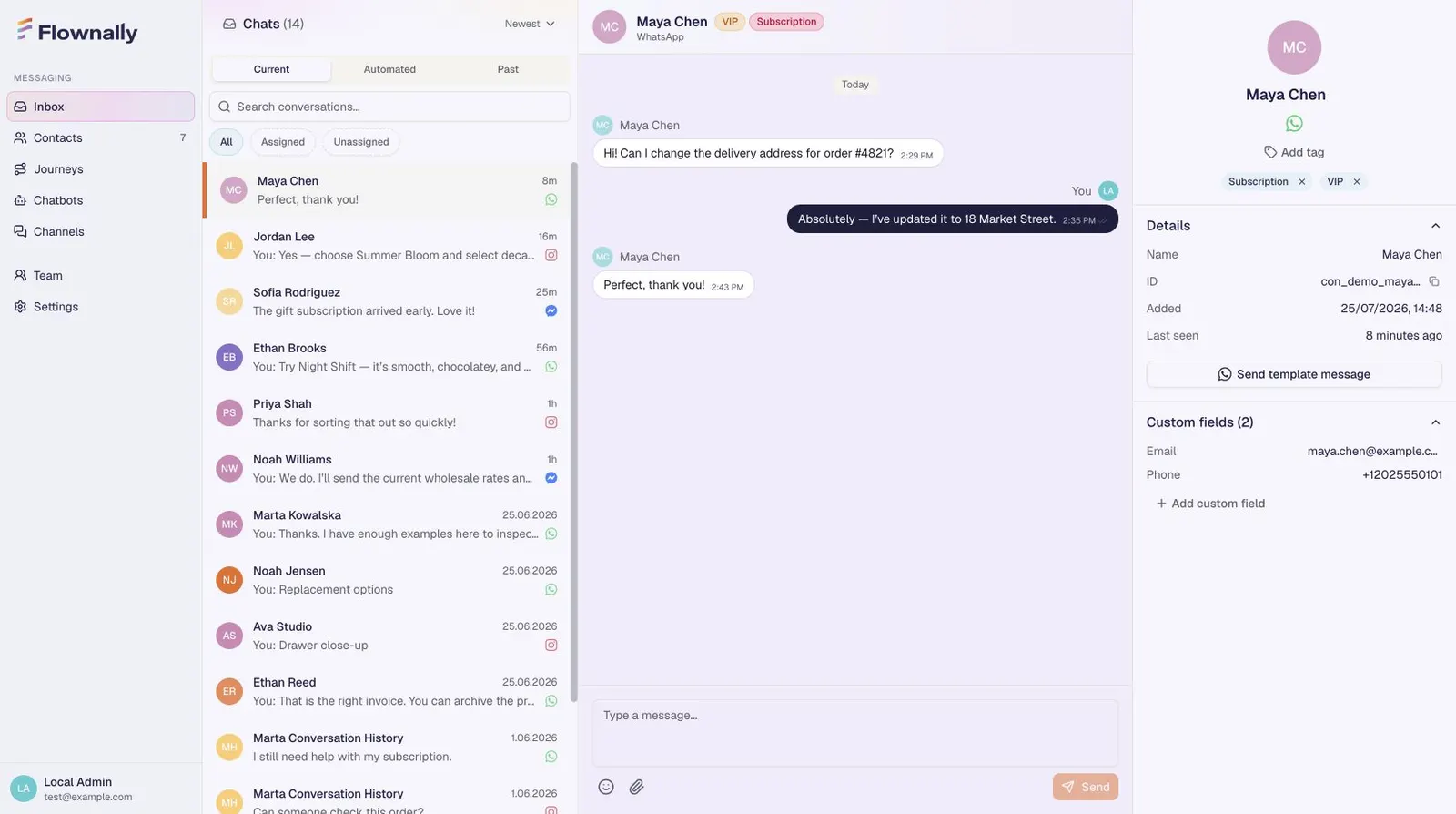
Conversation history → Customer context → Human handoff
Build an audience, send a relevant campaign or follow-up, track what happened, and continue customer replies inside the same workspace.
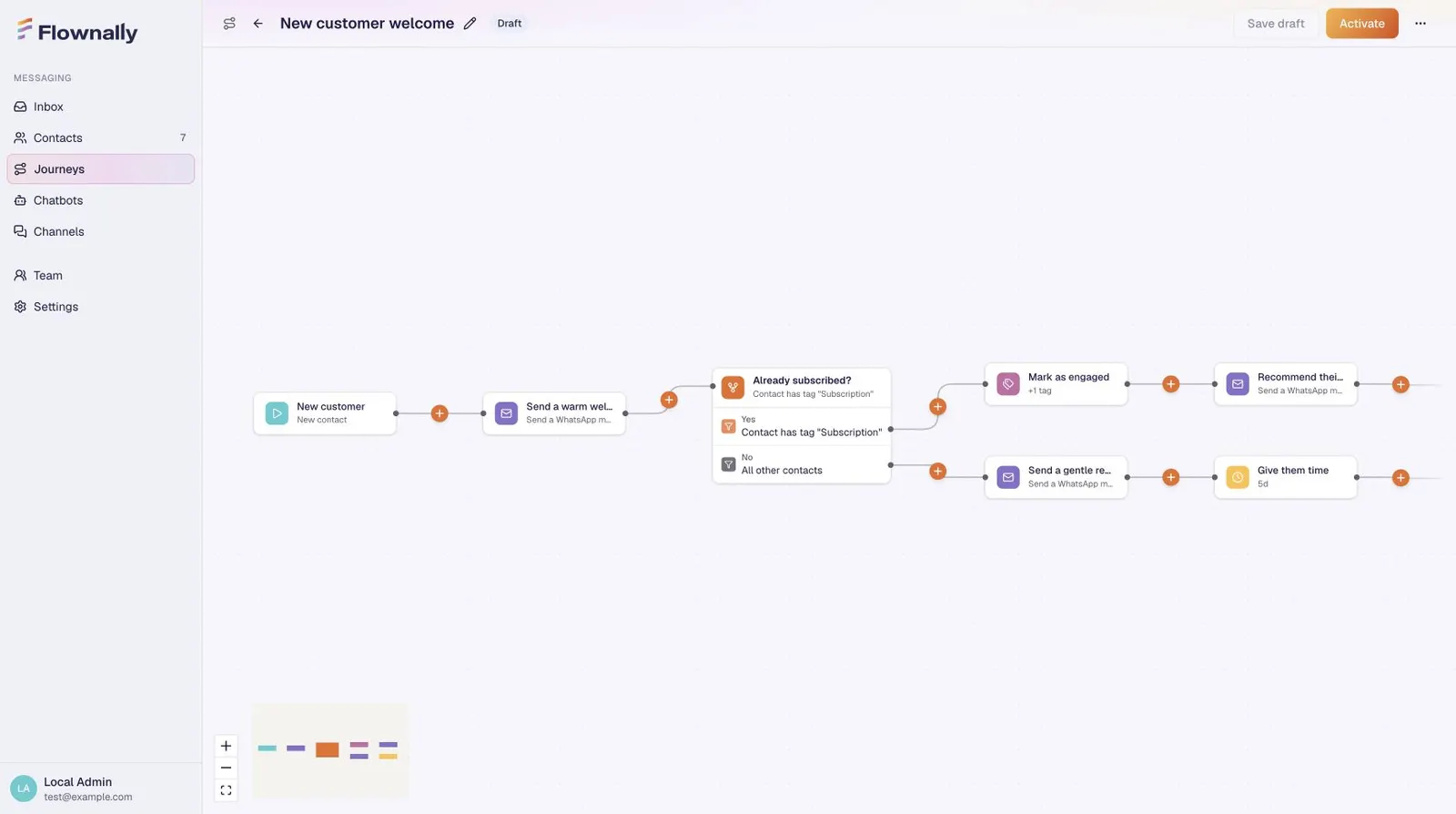
Segment → Message → Reply → Conversation
One connected journey
Whole journey scope
One conversation. Every next step connected.
01 — Ask
A customer asks about size, availability, materials, delivery, or which product is right for them.
02 — Understand
Intent Detection can identify what the customer needs. Chatbot and journey logic can then choose the appropriate path, answer predictable questions, and collect useful context.
03 — Advise
When the customer needs an individual answer, the conversation can move to the right person or team with its previous context visible.
04 — Buy
An event from Shopify or another ecommerce system can connect what happens in the store with what happens in the customer journey.
05 — Follow up
If a conversation or buying journey stops, Flownally can wait for the next event or trigger a relevant follow-up.
06 — Return
Post-purchase campaigns, reorder reminders, reactivation, or repeat purchase journeys can continue the relationship later.
Broad omnichannel commerce stack
SleekFlow currently combines AI Agents, an omnichannel Inbox, Broadcast Campaigns, Flow Builder, Shopify and API integration, with additional CRM and governance capabilities on higher plans.
If that broader stack matches the way your business operates, you may not need to replace SleekFlow.
Connected ecommerce conversations
Flownally's Journey Builder supports triggers, waits, conditions, events, and HTTP requests, while its Chatbot Builder supports rich messages, conditions, Intent Detector, and human handoff. Customer profiles, campaign audiences, and the shared inbox connect those workflows to the same customer context.
Flownally is not only an inbox or a chatbot. It connects customer messaging, contact data, automation, campaigns, ecommerce events, and human support around the same customer journey.
Customer journey first
You may not need another messaging platform. You may need to understand which capabilities your customer journey actually requires — and where your current setup is creating gaps or unnecessary work.
A free Flownally messaging strategy review starts with your customer journey — not a software walkthrough.
If SleekFlow's broader channel coverage, native Shopify integration, or AI Agent model is the better fit, we’ll tell you.
If Flownally fits the way your team wants to connect customer conversations, automation, campaigns, ecommerce events, and human support, we’ll show you how the journey could work.
Automation can understand what the customer needs, collect useful information, and route the conversation. When a buying decision needs individual advice, a person can continue from the point where automation stopped — with the existing customer context visible.
Customer
“I need a ring for an anniversary, but I’m not sure which style.”
Intent detected: Product recommendation
Journey: Route to Jewelry Advisors
Advisor
“I can help. Do you know whether she usually wears yellow or white gold?”
A customer asks a question, gets an answer, and disappears before buying. Journey logic can wait for a purchase or another business event. If it doesn’t happen, a relevant follow-up can bring the conversation back.
Customer
“Does it come in black?”
Automation
“Yes — want me to send you the link?”
No purchase event
Follow-up
“Still deciding? I can help.”
Purchase information can become the trigger for another relevant customer journey or campaign. Post-purchase guidance, replenishment reminders, product recommendations, and repeat purchase communication can use the customer context already collected earlier.
Event: order_created
Previous purchase: 30-day skincare
Journey waits: 25 days
Message
“Running low?”
Reorder
SleekFlow and Flownally both go far beyond basic messaging.
SleekFlow combines broad channel coverage, AI Agents, native commerce integrations, and sales and support capabilities.
Flownally combines messaging, customer data, automation, campaigns, human conversations, and API-connected business events around the same customer journey.
So the useful question is not which platform has the longest feature list. It is which workflow your ecommerce team actually needs to run.
See Flownally pricingFAQ
Yes, for the right ecommerce setup.
Both platforms provide customer messaging, automation, team workflows, customer data, campaigns, AI capabilities, and integrations.
Flownally can be a SleekFlow alternative for ecommerce teams that want WhatsApp, Instagram, Messenger, and SMS conversations connected with customer profiles, no-code chatbots, AI Intent Detection, visual journeys, campaigns, human handoff, and API-connected business events.
SleekFlow offers a broader channel footprint as well as capabilities such as AI Agents and a native Shopify integration. The better fit depends on the workflow your team actually needs.
Consider Flownally when you want customer messaging, contact data, automation, campaigns, human conversations, and ecommerce events to work together across the customer journey.
This can include product advice, intent-based chatbot routing, human handoff, abandoned-cart conversations, targeted campaigns, post-purchase communication, reorder reminders, and repeat-purchase journeys.
Flownally also supports custom integrations through API, external events, webhooks, and HTTP requests.
SleekFlow may remain the better fit if your business depends on its broader messaging channel coverage, autonomous AI Agent model, native Shopify integration, product and payment capabilities, or specific native CRM integrations.
If those capabilities are central to your operation and your current SleekFlow setup already works well, switching may not create meaningful additional value.
Yes.
SleekFlow provides an omnichannel Inbox, Flow Builder, Broadcast Campaigns and AI Agents. It also supports routing and integrated automation workflows.
The difference is not that SleekFlow lacks these capabilities.
Flownally's approach connects its shared conversation history with customer profiles, Journey and Chatbot Builders, AI Intent Detection, campaigns, human handoff, custom events and API-connected workflows.
Yes, Shopify can be connected to Flownally through API.
Shopify events and relevant customer or order data can be passed into Flownally and used to start or influence customer journeys. Flownally also supports custom events, webhooks, and HTTP requests for exchanging information with external systems.
The difference is that SleekFlow currently provides a ready-made native Shopify integration, while Flownally uses a configurable API-based approach. SleekFlow's native integration can synchronize customers, orders and abandoned cart data into its product.
Yes.
Flownally includes Intent Detection inside its chatbot automation. It analyzes what the customer says, identifies the intent, and can use that result to direct the customer to the appropriate conversation path.
This is different from SleekFlow's AI Agent model. SleekFlow positions AI Agents as autonomous agents that can handle sales and support tasks and, depending on the setup, use connected commerce or business data.
In some ecommerce setups, yes.
If your main workflow can be built around WhatsApp, Instagram, Messenger, and SMS and you need a shared inbox, customer profiles, chatbots, Intent Detection, automated journeys, campaigns, human handoff, and API-connected ecommerce events, Flownally can provide that system.
If you rely on SleekFlow-specific capabilities such as additional messaging channels, its native Shopify integration, autonomous AI Agents, or particular native CRM and commerce integrations, those requirements should be evaluated before switching.
You already have channels, customer data, automation, and people involved in the buying journey. The question is whether they are working as one system.
We’ll help you map the journey, identify where context or follow-up gets lost, and decide what should be automated, connected to business data, or handled by a person.
Your customer conversation journey
We start with your customer journey, not a software demo.