 Aleksandra Koszela, Product & CX Strategist at Flownally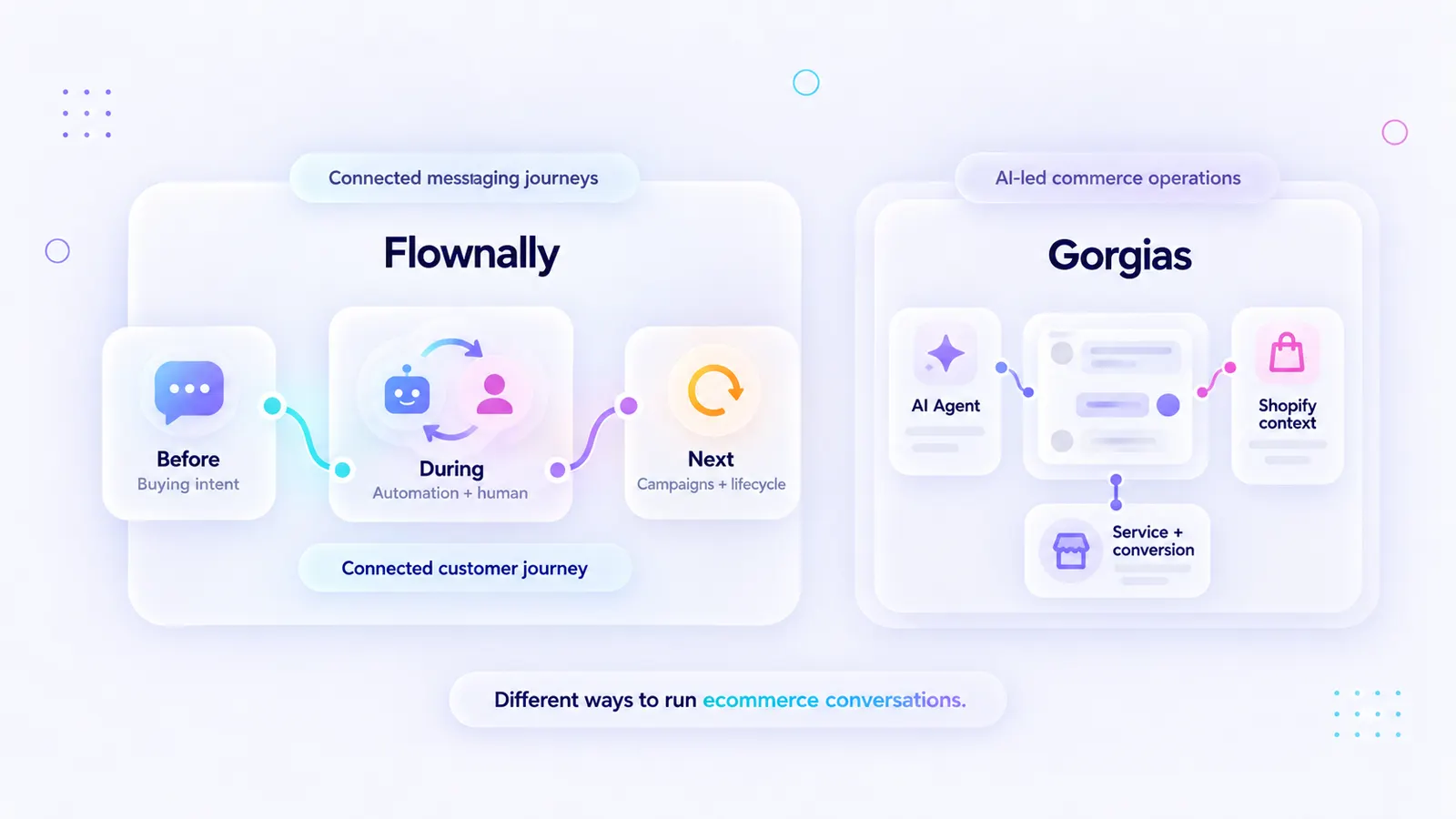
Flownally vs Gorgias for Ecommerce: 2026 Comparison
Flownally is the stronger fit for ecommerce teams that want conversations across WhatsApp, Instagram, Messenger, and SMS to connect with automation, human advice, campaigns, post-purchase communication, and repeat purchase.
Gorgias may fit better when Shopify is central to the operation and the business prioritizes autonomous AI, deep ecommerce context, email and website chat, high-volume service workflows, and proactive onsite selling.
Both are conversational commerce platforms, but they organize customer conversations differently. Flownally puts connected messaging journeys at the center, while Gorgias combines AI Agent, Helpdesk, ecommerce data, and onsite conversion capabilities in a platform built particularly deeply around Shopify.
- Flownally connects conversations across the customer lifecycle. Automation, human support, ecommerce events, campaigns, and later follow-ups can work around the same customer context.
- Gorgias has deeper native Shopify capabilities and more autonomous AI. Its AI Agent can independently handle eligible sales and service conversations.
- Their proactive communication models differ. Flownally focuses on WhatsApp campaigns and lifecycle journeys; Gorgias Convert focuses on proactive website conversations.
- Their channel strengths differ too. Flownally focuses on WhatsApp, Instagram, Messenger, and SMS, while Gorgias has a broader traditional service mix including email, website chat, and voice.
- Pricing scales differently. Flownally primarily scales by active contacts and support level, with all features available on every plan. Gorgias Helpdesk primarily scales by ticket volume, with additional charges for AI Agent and some add-ons.
Why Flownally vs Gorgias matters in 2026
The line between ecommerce sales and customer service is becoming less useful.
A shopper can discover a product on Instagram, ask a question in a DM, buy, return with a delivery issue, and later contact the same brand before another purchase.
Emplifi's 2026 research found that 86% of surveyed US and UK consumers are more likely to purchase from brands that respond on social media. It also found that 57% had contacted a brand through social media for customer service. Zendesk's 2026 CX Trends research adds another requirement: continuity. 74% of consumers find it frustrating to repeat their story to different agents, while 88% expect faster responses than they did a year earlier.
For ecommerce teams, that makes three moments particularly useful when comparing Flownally and Gorgias:
- 1Before: Where does customer intent appear?
- 2During: How do AI, automation, context, and people handle the conversation?
- 3Next: What can that conversation trigger later?
Flownally vs Gorgias: side-by-side comparison
Last updated: October 2026
| Category | Flownally | Gorgias |
|---|---|---|
| Best fit | Ecommerce teams that want messaging, automation, human advice, campaigns, and lifecycle journeys connected | Shopify-centered teams prioritizing autonomous AI, ecommerce context, service operations, and onsite conversion |
| Core model | Conversational commerce built around connected customer journeys, shared context, automation, campaigns, and human conversations | Conversational commerce combining AI Agent, Helpdesk, ecommerce context, and conversion tools |
| Main channels | WhatsApp, Instagram, Messenger, SMS | Email, website chat, social channels, WhatsApp, SMS, contact forms, voice |
| Automation | Visual journeys, chatbots, conditions, waits, events, HTTP requests, Intent Detector | AI Agent, Rules, Flows, ecommerce Actions, and other automation |
| AI approach | Intent recognition plus configurable automation and human handoff | Autonomous AI Agent for sales and service conversations |
| Proactive communication | WhatsApp campaigns plus event- and time-based journeys | Onsite Convert campaigns plus WhatsApp templates |
| Post-purchase | Follow-up journeys, campaigns, support, replenishment, and reactivation | AI and human service, order workflows, ecommerce actions |
| Ecommerce connectivity | Custom events, APIs, webhooks, HTTP requests | Deep Shopify integration plus integrations with other ecommerce systems |
| Pricing basis | Active contacts and support level; all features included across plans | Helpdesk ticket volume plus usage or outcome-based charges for additional products |
For a more commercial feature comparison, see Flownally vs Gorgias.
Before: where does buying intent enter the conversation?
Flownally is particularly suited to brands where messaging itself is part of the buying journey.
For example:
Instagram question → automation → human advice → purchase → post-purchase journey
or:
cart event → WhatsApp message → customer reply → advisor joins
The customer doesn't have to enter a traditional support process for the conversation to become useful. Messaging can start with buying intent and continue through automation, human advice, purchase, and later communication.
This is also why channels such as WhatsApp and Instagram matter differently from email-only service workflows: a conversation can begin while the customer is still deciding what to buy.
See how this approach can work for abandoned cart recovery, or read our guide to conversational commerce in ecommerce.
Gorgias also has strong pre-purchase capabilities, especially on the ecommerce website.
Gorgias Convert can proactively engage Shopify visitors through the website Chat widget based on conditions such as browsing or cart behavior. Campaigns can support pre-sales assistance, product education, upselling, and cross-selling.
That creates a useful distinction:
Flownally is particularly strong when buying intent appears in WhatsApp or other social messaging and needs to continue through a wider lifecycle.
Gorgias is particularly strong when Shopify and onsite conversations are major sales surfaces.
During: AI, automation, and human support
Flownally gives teams explicit control over what happens during the conversation.
Intent Detector can recognize the customer's need. A chatbot can collect information. Journey logic can decide what happens next. A person can join when individual advice or judgment becomes useful.
For example:
I'm buying this as a gift. Which size would you recommend?
The automated part can identify product advice and collect initial context before an advisor joins. This model works well when sales, customer experience, and support overlap.
See how Flownally's inbox, automation, campaigns, and customer journeys work together, or read what customer messages ecommerce brands should automate first.
Gorgias takes a more autonomous AI approach.
Its AI Agent can answer customer questions, use ecommerce context, perform supported actions, and resolve eligible conversations without human takeover. It currently works across email, Chat, SMS, and social channels. AI Agent support for Instagram DMs and Facebook Messenger arrived in July 2026 and is currently in beta; WhatsApp followed in open beta in September. These social-channel AI Agent capabilities currently require a Shopify store connected to Gorgias.
For a Shopify business that wants AI to independently complete a substantial share of repetitive customer interactions, Gorgias currently has the stronger autonomous AI offering.
For a team that wants automation to follow more explicitly designed paths and move between events, customer answers, and human judgment, Flownally may be the better fit.
Next: what happens after the conversation?
This is where Flownally's lifecycle model becomes especially relevant.
A conversation can influence what happens days or weeks later:
Product question → purchase → product guidance → WhatsApp campaign → reorder reminder
A purchase can trigger a journey. A journey can wait for another event. Customer context can determine another path. A later campaign can bring the customer back into a two-way conversation.
That makes the same communication system useful for:
- post-purchase education,
- replenishment,
- reactivation,
- relevant promotions,
- repeat purchase,
- and ongoing product guidance.
See our reorder reminder examples for ecommerce.
Gorgias also extends across pre- and post-purchase conversations. Its broader model combines AI Agent and Helpdesk with ecommerce context, while Convert adds proactive onsite engagement. Gorgias itself now positions the product as a conversational commerce platform for Shopify brands rather than simply a helpdesk.
The difference is therefore narrower than “support versus lifecycle.”
Flownally emphasizes orchestrated messaging journeys across WhatsApp and social channels, including outbound lifecycle communication.
Gorgias emphasizes AI-led conversational commerce with particularly deep Shopify context.
Shopify-native depth or ecommerce flexibility?
Gorgias has a clear advantage when deep native Shopify functionality is central to the buying decision. Shopify is fully compatible with Gorgias AI Agent, Flows, and Order Management. BigCommerce and Magento support some Gorgias automation capabilities, but not AI Agent or Order Management; WooCommerce and Prestashop have more limited compatibility.
Flownally takes a more system-independent approach. Journeys can respond to external events and exchange data through APIs, webhooks, custom events, and HTTP requests.
For example:
- order_created → send message
- delivery_completed → start follow-up journey
- customer event → choose another path
This gives teams more flexibility when their ecommerce operation isn't centered entirely on Shopify or when messaging needs to connect with several systems.
Explore Flownally for Ecommerce for the wider model.
WhatsApp, social messaging, and proactive communication
For Flownally, WhatsApp, Instagram, Messenger, and SMS are core customer-journey channels. They can connect with chatbots, automation, human handoff, customer context, ecommerce events, and later communication.
Flownally also supports targeted WhatsApp marketing campaigns, so the same relationship can move between inbound and outbound conversations.
For example:
purchase → post-purchase journey → relevant campaign → reply → human conversation
For Shopify-connected accounts, Gorgias AI Agent can also automate conversations on WhatsApp, Instagram DMs, and Facebook Messenger. These social deployments are currently in beta. Gorgias also has a strong onsite proactive commerce proposition. Convert campaigns appear through Gorgias Chat and can react to Shopify and browsing context. Convert uses separate click-based pricing for advanced campaigns. For a business built heavily around email, website chat, voice, and Shopify service workflows, Gorgias has an advantage.
For a business where WhatsApp and social messaging need to connect acquisition, sales conversations, campaigns, and retention, Flownally is likely to fit more naturally.
How does pricing compare?
The platforms use different pricing units, so comparing starting prices alone would be misleading.
Flownally
Every Flownally plan includes all product features and unlimited users.
Plans primarily differ by active-contact volume and support level:
| Plan | Monthly price | Active contacts |
|---|---|---|
| Starter | $19 | Up to 100 |
| Professional | $199 | Up to 1,000 |
| Ultimate | $499 | Up to 10,000 |
| Custom | Tailored | Custom volume |
Annual billing is 25% lower.
This means a smaller team doesn't have to upgrade simply to unlock journeys, campaigns, chatbots, or integrations.
See current Flownally pricing.
Gorgias
Gorgias Helpdesk primarily scales by billable ticket volume. Its current plans start at $10/month for 50 tickets, followed by $60 for 300, $360 for 2,000, and $900 for 5,000.
AI Agent adds an outcome-based charge when it fully resolves a conversation. Gorgias currently states that most annual plans charge around $0.90 per AI-resolved interaction, while monthly pricing is generally $1. Voice and SMS are paid add-ons, and Convert has its own pricing.
For decision-makers, total cost should therefore account for active customers, ticket volume, AI usage, messaging fees, required channels, and the remaining human work.
Three ecommerce scenarios
1. Social- and WhatsApp-led DTC brand
A beauty or jewelry brand receives pre-purchase questions through Instagram and WhatsApp. Automation handles predictable questions. Advisors join higher-intent conversations. After purchase, customers can enter product-education journeys, campaigns, and later follow-ups.
Flownally is likely the stronger fit.
The main requirement is keeping customer conversations connected across sales, automation, human support, and later lifecycle moments.
2. Brand focused on repeat purchase
A consumables business wants purchases to trigger onboarding and later replenishment communication.
Customer actions can influence what happens next, while replies can move into automation or directly to an advisor.
Flownally is likely the stronger fit.
The value comes from coordinating communication across time rather than optimizing only the immediate interaction.
3. High-volume Shopify operation
A Shopify retailer handles substantial volumes through email and website chat and wants deep order context, autonomous AI resolution, ecommerce actions, and proactive onsite selling.
Gorgias is likely the stronger fit.
Its native Shopify depth, AI Agent, and Convert capabilities align closely with this operating model.
Which is better for ecommerce: Flownally or Gorgias?
Choose Flownally when your customer communication strategy centers on WhatsApp, Instagram, Messenger, and SMS and those conversations need to connect:
- automation,
- human advice,
- campaigns,
- ecommerce events,
- post-purchase communication,
- and future purchases.
Flownally can start as a central workspace for customer conversations and become more deeply connected with ecommerce systems as the business grows.
Choose Gorgias when Shopify-native depth, autonomous AI, email and website chat, ecommerce actions, high support volumes, or onsite conversational selling are stronger priorities.
Neither comparison comes down to the number of features. The better platform depends on where conversations happen and what you want them to do for the business next.
Is Flownally a Gorgias alternative?
Yes.
Flownally is particularly relevant as a Gorgias alternative for ecommerce teams that want customer messaging to extend beyond resolving the immediate conversation.
Its combination of messaging channels, chatbots, Intent Detector, human handoff, no-code journeys, campaigns, and event-based automation supports conversations across sales, service, retention, and repeat purchase.
Gorgias remains stronger in areas such as autonomous AI and deep native Shopify functionality.
For the commercial feature comparison, visit Flownally vs Gorgias.
How should you choose between Flownally and Gorgias?
Take one real customer journey and answer three questions:
Before: Where does the customer usually start the conversation — WhatsApp, Instagram, website chat, or email?
During: Do you want autonomous AI resolution or more explicitly controlled automation with human handoff?
Next: Should that interaction end when the immediate problem is solved, or trigger another relevant customer journey later?
Then compare the total cost of the setup you would actually use. That usually tells you more than a long feature checklist.
Comparing Flownally with other ecommerce messaging platforms?
Different platforms represent different buying decisions.
If you're comparing Flownally with a broader platform that combines more channels, autonomous AI, and native commerce capabilities, see Flownally vs SleekFlow.
If your priority is social engagement automation, Instagram triggers, and comment-to-DM workflows, read our Flownally vs Manychat for Ecommerce comparison.
You can also explore all Flownally alternatives and comparisons to compare different approaches to customer messaging, automation, AI, support, and ecommerce journeys.
Bring customer conversations, automation, campaigns, human support, and follow-up journeys into one connected system.

FAQ
Flownally focuses on connected messaging journeys across WhatsApp, Instagram, Messenger, and SMS, combining automation, human support, campaigns, ecommerce events, and lifecycle communication.
Gorgias is a conversational commerce platform with particularly deep Shopify capabilities, an autonomous AI Agent, Helpdesk, website Chat, and onsite Convert campaigns.
Yes. Flownally can be a strong Gorgias alternative when customer messaging needs to connect sales, automation, human support, campaigns, post-purchase communication, and repeat purchase.
See the full Flownally vs Gorgias feature comparison.
Flownally can connect customer journeys with Shopify and other ecommerce systems using events, APIs, webhooks, and HTTP requests.
Gorgias currently has deeper native Shopify capabilities, including support for AI Agent and Order Management.
Gorgias may fit better when deep native Shopify functionality is essential. Flownally may fit better when flexibility and connected messaging journeys matter more.
Yes. Flownally includes an Intent Detector that identifies what a customer is asking and routes the conversation to the relevant path.
It combines intent recognition with configurable chatbots, customer journeys, business events, and human handoff.
Gorgias currently has the stronger autonomous AI offering. AI Agent can independently handle and resolve eligible customer interactions, including on supported social messaging channels. Its first-party AI Agent currently requires a Shopify-connected store.
Flownally uses AI for Intent Detector and combines it with structured automation, business events, and human handoff.
Flownally is particularly strong when WhatsApp needs to support chatbots, automated journeys, human conversations, campaigns, ecommerce events, and later follow-ups.
Gorgias also supports WhatsApp, but within a wider service environment that includes email, website chat, SMS, and voice.
All Flownally plans include every product feature and unlimited users.
Monthly pricing starts at $19 for Starter, followed by $199 for Professional and $499 for Ultimate. Plans primarily scale by active-contact volume and support level, and annual billing is 25% lower.
Gorgias Helpdesk primarily scales by billable ticket volume. AI Agent adds outcome-based charges for conversations it resolves autonomously, while Voice, SMS, and Convert can introduce additional usage costs.
Choose Flownally when customer conversations need to connect messaging, automation, human support, campaigns, ecommerce events, and later lifecycle moments.
Consider Gorgias when Shopify-native functionality, autonomous AI, high-volume service operations, email and website chat, or proactive onsite selling are the main priorities.