 Aleksandra Koszela, Product & CX Strategist at Flownally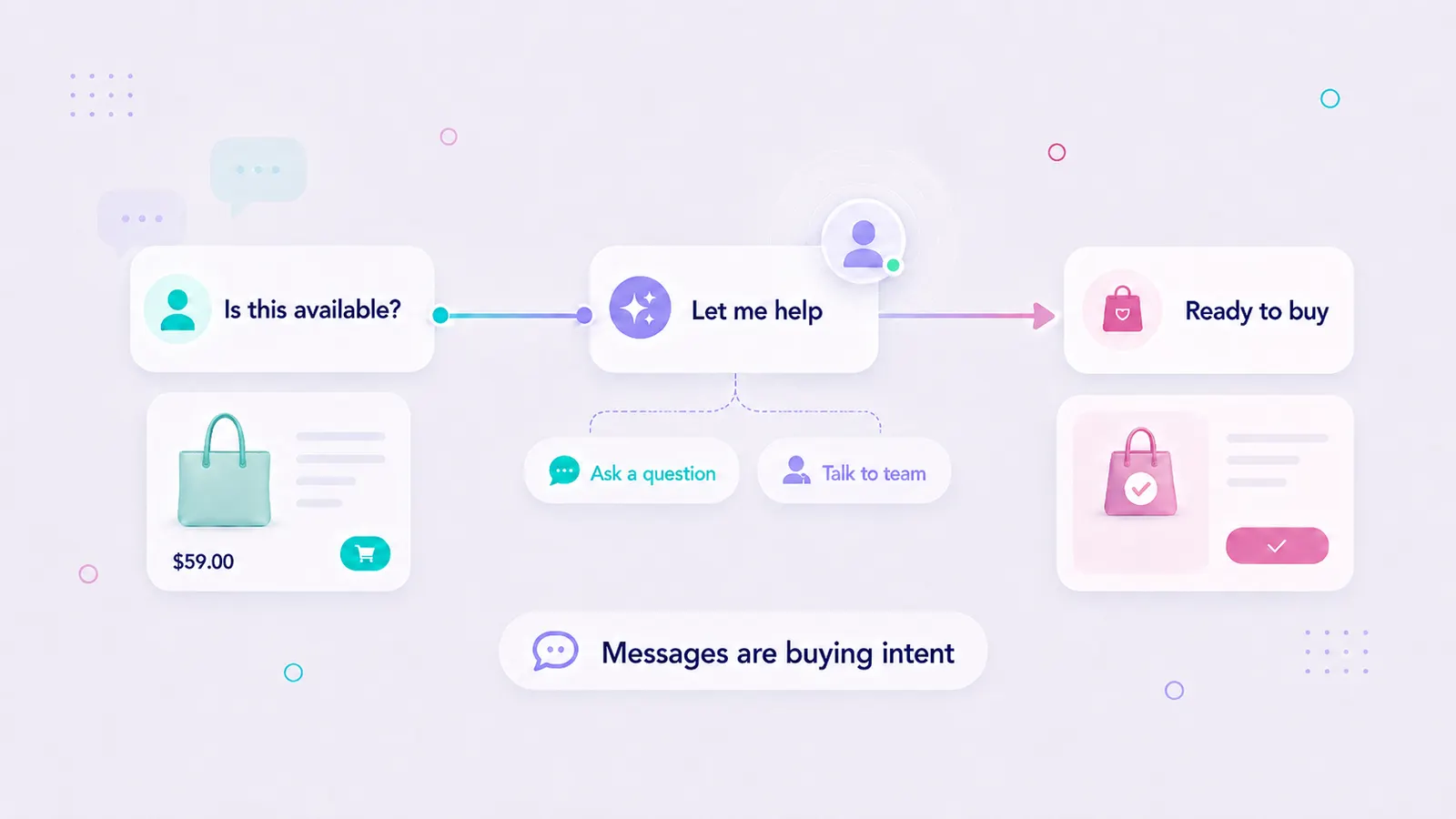
What Is Conversational Commerce in Ecommerce? How Brands Turn Messages Into Sales
Conversational commerce in ecommerce means using customer conversations to guide shoppers before, during, and after purchase.
It happens on channels like WhatsApp, Instagram, Messenger, SMS, and live chat, where customers already ask about products, sizing, delivery, payment options, returns, and reorders.
A strong conversational commerce system combines a shared inbox, automation, customer context, follow-up logic, and human handoff. It helps ecommerce teams turn messages into part of the buying journey, not just customer support.
Flownally helps ecommerce brands manage and automate conversations across WhatsApp, Instagram, Messenger, and SMS, so teams can respond faster, keep context, and move customers closer to purchase.
- Conversational commerce turns customer messages into guided buying moments.
- It supports product discovery, product advice, checkout help, abandoned cart recovery, post-purchase care, reorder reminders, and reactivation.
- It’s broader than live chat and bigger than a chatbot.
- It works best when automation and human support are connected.
- Ecommerce teams need one shared system for customer conversations, not disconnected inboxes for every channel.
- Flownally helps brands manage messaging channels, automate predictable steps, keep context visible, and hand off conversations when a customer needs a person.
What is conversational commerce in ecommerce?
Conversational commerce is the use of messaging conversations to help customers discover products, ask questions, make decisions, complete purchases, and buy again.
In ecommerce, this usually happens across channels such as:
- Instagram DMs,
- Messenger,
- SMS,
- live chat,
- and sometimes email.
The important part isn’t the channel, but the behavior.
A customer sees a product and asks:
Is this available?
What size should I choose?
Can I pay in installments?
Will it arrive before Friday?
Can you recommend something similar?
These questions aren’t just support tickets. They’re buying signals.
Some teams call this conversational commerce. Others call it messaging commerce, chat commerce, social messaging sales, or customer messaging automation. The wording can change. The behavior is the same: customers ask buying questions in messages, and brands need a system to respond with speed, context, automation, and human help when needed.
Flownally’s view: messages are buying intent
At Flownally, we see customer messages as buying intent, not inbox clutter. When a customer asks about size, availability, delivery, payment, or product fit, they’re showing where the buying journey needs help.
That’s why conversational commerce needs more than a chatbot. It needs a shared inbox, customer context, automation for predictable steps, follow-up logic, and a clear path to a team member when the customer needs advice.
The goal is to make every useful conversation easier to continue, not to send more messages.
Why conversational commerce matters now
For years, ecommerce teams focused on bringing customers to the website. And of course, that still matters.
But the website isn’t the only place where buying decisions happen. Discovery happens on social platforms. Product research happens in search and AI tools. Questions happen in DMs. Purchase intent shows up in messages.
A 2026 SparkToro and Similarweb analysis found that less than one-third of Google searches still send a click. SparkToro also reported that the traffic share Google sends to tens of thousands of sites in its panel dropped by 8 percentage points from June 2025 to May 2026. This doesn’t mean websites are dead; it means traffic alone isn’t enough.
At the same time, social and messaging channels are becoming more important parts of the buying journey. EMARKETER reports that US retail social commerce sales will surpass $100 billion in 2026. Meta and the Retailers Association of India also reported in 2026 that WhatsApp is becoming a commerce engine across discovery, purchase, and post-purchase journeys. In the same retail context, brands using Business Messaging and Click-to-WhatsApp campaigns saw a 61% average ROAS improvement, 62% more leads, and 22% higher order values.
The point is that more buying moments now happen before, around, and after the website.
Shopify’s 2026 Ecommerce Growth Guide points to a similar shift. Ecommerce growth now depends not only on acquisition, but also on conversion lift, repeat purchase rate, CAC:LTV, channel unification, and operational efficiency.
That’s where conversations matter. A customer who messages your brand is already doing something valuable: they’re raising their hand.
Conversational commerce isn’t just customer support
Customer support usually starts after something goes wrong. Conversational commerce can start much earlier.
It can happen when a customer is:
- discovering a product,
- comparing options,
- asking about size or fit,
- checking availability,
- asking about delivery,
- choosing a payment method,
- abandoning a cart,
- waiting for an order,
- deciding whether to reorder,
- coming back after a previous purchase.
The best place to start is knowing what customer messages ecommerce brands should automate first, and which ones should still go to a person.
A good conversation can remove doubt before purchase or recover a sale that would otherwise be lost. It can turn a first purchase into a second one or make a customer feel guided instead of pushed.
Social commerce vs conversational commerce
Social commerce and conversational commerce are connected, but they aren’t the same.
Social commerce usually means customers discover or buy products through social platforms. Conversational commerce means the buying journey is supported by direct messages and real conversations.
A customer may discover a product on Instagram. That’s social commerce. Then they send a DM asking if the product is available in another color. That’s conversational commerce. When more discovery happens inside social platforms, more questions happen there too. Brands need a way to manage those questions without losing context.
Where conversations influence ecommerce sales
Conversational commerce can support many parts of the ecommerce journey.
Product discovery
A customer sees a product in a post, ad, story, or creator recommendation and asks:
Is this available in beige?
Automation can answer simple availability questions. A team member can step in if the customer needs advice.
Product advice
Some products need more explanation. Fashion, beauty, jewelry, supplements, baby products, electronics, and home goods often trigger questions before purchase.
Examples:
What size should I choose?
Which serum should I use first?
Is this gift appropriate for a wedding?
Automation can collect basic context. A person can help with the decision.
Checkout support
A customer is interested, but something blocks the purchase.
Examples:
Can I pay in installments?
Do you ship to Germany?
Can I get this by Friday?
These are high-intent questions. If they sit unanswered, the sale may disappear.
Abandoned cart recovery
Not every abandoned cart needs a discount. Sometimes the customer had one unresolved question.
A useful message can say:
Still thinking about the jacket? I can help with sizing or delivery.
That feels different from a generic discount blast.
Post-purchase care
After the purchase, conversations can reduce anxiety and build trust. Customers may ask about delivery, returns, care instructions, product setup, or next steps. Good post-purchase messaging helps customers get value from what they bought. That makes repeat purchases more likely later.
Reorders and repeat purchases
For consumable products, conversational commerce can support reorder reminders. For high-consideration products, it can support future recommendations.
The principle is the same:
Use customer context to send a relevant message at the right moment.
The Flownally Conversational Commerce Framework
Conversational commerce doesn’t work well when every channel is managed separately.
A practical system needs five connected parts.
1. One shared inbox
Your team needs one place to see customer conversations across WhatsApp, Instagram, Messenger, SMS, and other messaging channels.
That makes it easier to assign work, avoid duplicate replies, and see what still needs attention.
2. Customer context
A conversation is more useful when the team can see what happened before.
Previous messages, product interest, order context, channel source, and preferences all help the team respond better.
3. Automation for predictable steps
Not every message needs a manual reply.
Automation can help with common questions, order updates, product guidance, quick replies, post-purchase messages, and follow-ups.
The goal is to reduce repetitive work, not to replace the team.
4. Human handoff
Some moments need judgment.
A customer choosing a high-value product, changing an order, asking for advice, or explaining a specific problem should have a clear path to a person.
This is what keeps automation from feeling robotic.
5. Follow-up logic
Conversations often need a next step.
That could be an abandoned cart follow-up, a post-purchase message, a review request, a reorder reminder, or a reactivation flow.
Without follow-up logic, buying intent gets lost in the inbox.
How Flownally helps you build these 5 things
Flownally helps ecommerce teams turn the conversational commerce framework into a working messaging system.
- For the shared inbox, Flownally brings WhatsApp, Instagram, Messenger, and SMS conversations into one workspace.
- For customer context, Flownally keeps conversation history visible so the team can understand what the customer asked before.
- For automation, Flownally helps automate predictable steps such as common product questions, post-purchase messages, follow-ups, and reorder reminders.
- For human handoff, conversations can move from automation to a team member when the customer needs advice, a custom answer, or help with a higher-value purchase.
- For follow-up logic, Flownally helps brands build journeys that connect product questions, checkout moments, post-purchase care, and repeat purchase opportunities.
The result is a clearer system for moving customer conversations toward the next useful step.
Why choose Flownally for conversational commerce?
Many ecommerce teams already use tools that solve one part of the problem.
- A chatbot can answer repetitive questions.
- A live chat widget can support website visitors.
- An SMS tool can send short updates.
- Meta Business Suite can help manage social messages.
But conversational commerce breaks down when these tools stay disconnected.
The team may answer quickly in one channel but miss context from another. Automation may reply, but no one owns the follow-up. A customer may ask a buying question, but the message is treated like a support ticket.
Flownally is built around the full customer conversation, not only one channel or one automation.
With Flownally, ecommerce brands can:
- manage WhatsApp, Instagram, Messenger, and SMS conversations in one shared workspace,
- use automation to answer predictable questions and guide customers through routine steps,
- keep previous messages visible before a team member replies,
- hand off conversations when a customer needs advice or a custom answer,
- build post-purchase and repeat purchase journeys,
- create follow-ups for moments such as abandoned carts, product recommendations, reorder reminders, and reactivation,
- reduce missed buying signals across DMs and text messages.
This matters because conversational commerce is about building a system where customer messages can move the buying journey forward, not just answering faster.
What this looks like in practice
Example 1: Fashion brand
A customer sends an Instagram DM:
Does this dress run small?
Automation asks for the customer’s usual size and fit preference. A team member steps in with a recommendation. The customer gets a product link and a delivery estimate. The conversation helped the customer decide.
Example 2: Beauty brand
A customer asks on WhatsApp:
Which cleanser should I use with this serum?
Automation collects skin type and routine goal. The team recommends a product combination. After purchase, the customer receives usage guidance. Later, the brand sends a reorder reminder before the product runs out.
The conversation supports both the first purchase and the next one.
Example 3: High-value cart
A customer abandons a high-value cart. Instead of sending only a discount, the brand sends:
Still considering your order? I can help with payment options or product questions.
The customer replies:
Can I pay in installments?
A person steps in. The sale moves forward because the customer got the one answer they needed.
Build around conversations, not just traffic
Website traffic, landing pages, and checkout still matter. But ecommerce brands can’t assume that every buying journey will move neatly through a website funnel.
Customers discover products in one place. Ask questions in another. Compare options somewhere else. Then come back when the timing is right.
Conversational commerce helps brands manage that reality. The opportunity is to treat customer messages as intent. When a customer starts talking to your brand, the buying journey has already begun.
Want to see which customer messages could support sales, support, and repeat purchases?
Book a free messaging strategy review with Flownally and map the WhatsApp, Instagram, Messenger, and SMS moments worth turning into automated journeys.


FAQ
Conversational commerce is the use of messaging conversations to help customers discover products, ask questions, make decisions, complete purchases, and buy again.
In ecommerce, conversational commerce means using channels like WhatsApp, Instagram, Messenger, SMS, and live chat to support the buying journey before, during, and after purchase.
No. Customer support usually handles questions or problems. Conversational commerce can include support, but it also covers product discovery, recommendations, checkout help, cart recovery, post-purchase care, and repeat purchases.
No. A chatbot can be part of conversational commerce, but it isn’t the whole system. Conversational commerce also needs a shared inbox, customer context, automation, follow-ups, and human handoff.
Live chat is usually one channel on a website. Conversational commerce is broader. It can include WhatsApp, Instagram DMs, Messenger, SMS, and live chat, and it supports the buying journey across product discovery, advice, checkout, post-purchase care, and repeat purchases.
Common channels include WhatsApp, Instagram DMs, Messenger, SMS, live chat, and sometimes email. The best channels depend on where customers already ask questions and make decisions.
WhatsApp supports conversational commerce by giving customers a direct way to ask questions, receive order updates, get product recommendations, recover abandoned carts, and continue post-purchase conversations.
Yes. Instagram DMs often capture buying intent after a customer sees a product in a post, story, ad, or creator recommendation. A shared inbox helps the team manage those messages and connect them with the rest of the customer journey.
Social commerce focuses on product discovery and shopping through social platforms. Conversational commerce focuses on direct conversations that help customers decide, buy, and return.
Conversational commerce is sometimes called messaging commerce, chat commerce, direct commerce, social messaging sales, or customer messaging for ecommerce. These terms usually refer to the same idea: using channels like WhatsApp, Instagram, Messenger, SMS, or live chat to help customers decide, buy, and return.
A conversational commerce system needs one shared inbox, customer context, automation for predictable steps, clear human handoff, and follow-up logic for moments like abandoned carts, post-purchase care, reorders, and reactivation.
Yes. Conversational commerce can increase Average Order Value when customers receive timely product advice, bundles, complementary recommendations, payment options, or help choosing a higher-value product. The goal isn’t to push more products, but to remove uncertainty and guide the customer toward the right purchase.
Conversational commerce can reduce CAC payback by helping brands convert more of the customers they already paid to acquire. When customer questions, abandoned carts, post-purchase follow-ups, and repeat purchase moments are handled through messaging, each acquired customer has more chances to convert and buy again.
Yes. Conversational commerce can support repeat purchases through post-purchase care, replenishment reminders, future product recommendations, reactivation flows, and personalized follow-ups based on customer context.
Yes, but the journey usually looks different. In B2B, conversational commerce may support lead qualification, product questions, demo requests, onboarding, account expansion, and renewal conversations. This article focuses on ecommerce, where the most common use cases are product advice, checkout support, cart recovery, post-purchase care, and repeat purchases.
Flownally helps ecommerce teams manage and automate conversations across WhatsApp, Instagram, Messenger, and SMS. It centralizes messages, keeps context visible, supports automation, and lets team members step in when the customer needs human help.
No. Smaller ecommerce brands can also use conversational commerce, especially when customer questions already influence sales. The system can start simple: one shared inbox, a few automated answers, and clear handoff to the team.