 Aleksandra Koszela, Product & CX Strategist at Flownally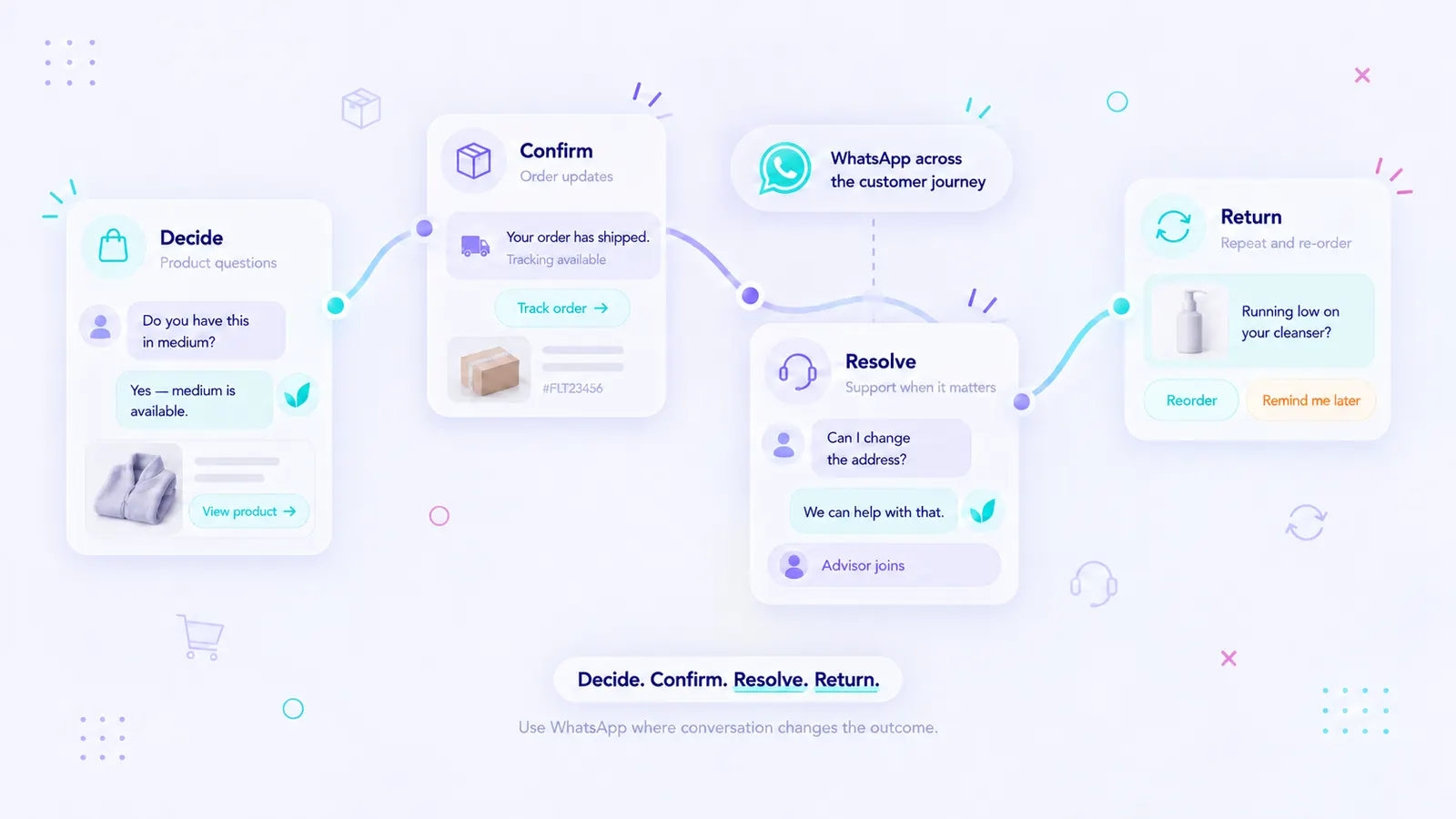
WhatsApp for Ecommerce: How to Use It Across the Customer Journey in 2026
WhatsApp for ecommerce works best at moments where speed, context, and the ability to reply can change what happens next — rather than at every possible customer touchpoint.
A useful way to structure this is Decide → Confirm → Resolve → Return: help customers choose or complete a purchase, confirm what happened after they acted, resolve questions or problems, and give them a relevant reason to return.
WhatsApp performance should connect to business outcomes such as conversion rate, AOV, repeat purchase rate, support efficiency, and CAC payback, alongside message volume and cost.
Flownally helps ecommerce teams connect WhatsApp automation, customer context, human handoff, and follow-up journeys so these moments work as one customer journey.
- Use WhatsApp where conversation adds value. Product questions, purchase hesitation, delivery issues, complex support, and repeat-purchase moments are stronger use cases than sending every possible notification.
- Think in customer decisions, not message types. A useful framework is Decide → Confirm → Resolve → Return.
- WhatsApp can support revenue before and after checkout. Its role can include product advice, abandoned cart recovery, order communication, post-purchase support, replenishment, and reactivation.
- Automation should handle predictable work. Human advisors become more valuable when the conversation needs judgment, empathy, negotiation, or product expertise.
- Connect WhatsApp to customer and order context. The right message depends on what the customer asked, bought, received, or did next.
- Measure commercial outcomes alongside messaging activity. Conversion, AOV, repeat purchase rate, resolution efficiency, and cost per outcome matter more than message volume alone.
- Flownally connects WhatsApp with Instagram, Messenger, SMS, automation, shared conversation history, and human support in one workspace.
Why WhatsApp matters for ecommerce in 2026
Ecommerce growth is getting harder to buy.
Shopify’s 2026 Ecommerce Growth Guide reports that customer acquisition costs are up 8.64% year over year. Shopify highlights conversion improvement, repeat purchases, channel unification, and operational efficiency as important growth levers for ecommerce brands in 2026.
That changes the role of customer communication.
Once a brand has paid to generate attention, the next opportunity often comes from helping an existing shopper move forward rather than simply buying another click.
Messaging is increasingly part of that behavior.
Meta and Kantar’s 2026 State of Business Messaging study surveyed 11,056 adults across 22 markets. It found that 73.3% prefer messaging when communicating with a business, while 72.4% are more likely to purchase from a brand that offers messaging.
WhatsApp can be particularly relevant when customers need a quick answer before acting.
Meta and the Retailers Association of India reported in 2026 that WhatsApp had become a major discovery and conversion channel in the Indian retail market. In that research, retailers using Business Messaging and Click-to-WhatsApp campaigns reported a 61% average improvement in ROAS and 22% higher order values. These figures come from the Indian retail context, so they shouldn't be treated as universal benchmarks, but they show the commercial role messaging can play when it's connected to the buying journey.
The opportunity for ecommerce teams is broader than sending campaigns. A customer might use WhatsApp to decide, confirm, resolve, or return.
Those four jobs create a useful map for the channel.
1. Decide: use WhatsApp when a customer needs help buying
A customer reaches a product page. They like the product, but one unanswered question remains:
Does this run small?
Or:
Can this arrive before Friday?
Or:
Which one would you recommend for sensitive skin?
These are high-value moments because the shopper has already shown intent. WhatsApp can remove the uncertainty standing between interest and purchase.
For straightforward questions, automation may answer immediately. Product availability, delivery rules, basic sizing, payment options, or simple product comparisons can often follow clear logic.
More considered purchases may need a person.
A jewelry customer choosing an engagement ring, for example, may need advice on budget, style, delivery timing, certification, and ring size. Automation can collect some of that context before an advisor joins.
This makes WhatsApp useful for assisted conversion, not only customer service.
The broader behavior is part of conversational commerce: using customer conversations to support product discovery, purchase, support, and future buying moments. Our guide to What Is Conversational Commerce in Ecommerce? explores that model in more detail.
WhatsApp can also recover unfinished buying decisions
An abandoned cart often represents an unresolved question rather than a customer who simply forgot to buy.
The hesitation might be:
Will it arrive on time?
Can I exchange the size?
Is this the right product for me?
A useful recovery message can give the shopper a path back into the conversation:
Still thinking about the linen dress? I can help with sizing, delivery, or returns.
That creates more room for a real answer than a generic discount reminder.
For the full framework, see How to Recover Abandoned Carts With WhatsApp, SMS, and Customer Messaging.
2. Confirm: use WhatsApp to reduce post-purchase uncertainty
After checkout, customers want confidence that everything is moving as expected. WhatsApp can help confirm important moments such as an order being accepted, shipped, delayed, or delivered.
The useful question for an ecommerce team is:
Which events does the customer actually need to know about?
Your fulfillment system may contain:
Order created → Payment received → Processing → Packed → Shipping label created → Shipped → Out for delivery → Delivered
That doesn't automatically require eight WhatsApp messages. Some backend events are operationally important while adding very little for the customer. A simpler customer-facing journey might communicate:
Order confirmed → Shipped → Delivered
A delayed shipment may deserve an additional update because something changed that the customer cares about. This distinction becomes increasingly important as messaging volume grows.
From October 1, 2026, WhatsApp Business Platform pricing changes also add a direct cost consideration. Utility messages inside the 24-hour customer service window become billable, while each business phone number receives 1,000 free service messages per month before additional service replies are charged. Flownally's WhatsApp Business API Pricing Calculator 2026 can estimate the impact based on your message volumes and recipient markets.
Message design therefore affects customer experience, operational efficiency, and cost.
3. Resolve: use WhatsApp where customers need an answer quickly
Many post-purchase conversations begin with a simple question:
Where is my order?
Can I change the address?
I received the wrong size.
My parcel says delivered, but it isn't here.
The first question may be easy to automate. The last three may require more judgment.
A strong WhatsApp setup lets predictable questions move quickly while giving complicated cases a clear route to a person. Automation can retrieve information, collect an order number, recognize the reason for contact, or guide the customer through basic steps.
When something becomes unusual, emotional, or commercially sensitive, a team member should be able to continue from the existing context. The customer shouldn't need to start again.
This is where a shared inbox becomes more important than automation alone. If a chatbot has already collected the order number and identified a delivery problem, the advisor should see both before replying.
For a deeper framework on this division of work, see what customer messages ecommerce brands should automate first.
4. Return: use WhatsApp when there’s a relevant next purchase
The customer journey doesn't end at delivery. For many ecommerce categories, the next revenue opportunity depends on what happens after purchase.
A skincare customer may need product guidance and later a replenishment reminder. A coffee customer may run out after three weeks. A jewelry customer who bought an engagement ring may later need wedding rings or an anniversary gift. A pet-food customer may need the same product again on a predictable cycle.
WhatsApp works especially well when the next action is simple and the customer may want to reply.
For example:
Your cleanser may be running low soon. Want another one, or should we remind you later?
The message opens several valid paths:
- The customer can reorder.
- They can postpone.
- They can ask for another product.
- They can say the original product didn't work for them.
- That reply contains useful customer context.
A good repeat-purchase system can use it to change what happens next instead of sending the same reminder again.
For practical copy examples, see Reorder reminder message examples for ecommerce.
The strongest WhatsApp journeys don't use WhatsApp for everything
Channel choice matters:
- A detailed care guide may work better in email.
- A live parcel map belongs on a tracking page.
- Long documentation is easier to manage in a Help Center.
- Instagram may be the natural place to continue a conversation that started from a Reel or Story.
- WhatsApp becomes particularly useful when the customer needs to reply, decide, clarify, confirm, or act quickly.
This creates a better channel strategy than turning every lifecycle event into another WhatsApp notification.
A decision-maker can ask a simple question:
Would a conversation improve this customer moment?
If the answer is yes, WhatsApp deserves consideration. If the customer mainly needs to read, browse, or passively check information, another channel may do the job better.
How should automation and human support work together?
The most scalable WhatsApp setup doesn't require a person to type every reply. It also doesn't trap every customer inside automation.
A practical division of work is:
- Predictable → automate.
- Customer-dependent → collect context.
- Judgment-dependent → hand off.
A delivery-policy question may be predictable. A sizing recommendation can depend on customer information. A complaint about a damaged high-value product may need judgment and empathy.
The same logic applies before and after purchase.
This balance matters commercially because human time has a cost too. Automation can remove repetitive work while keeping expert attention available for conversations where it has the greatest impact.
If your team is moving beyond manual WhatsApp management, our guide to WhatsApp Business App vs WhatsApp Business API explains when the Platform/API becomes relevant for automation, integrations, multiple team members, templates, and shared conversation management.
What should ecommerce leaders measure?
WhatsApp reporting becomes more useful when you tie message activity to customer and financial outcomes.
For pre-purchase conversations, look at assisted conversion rate, product-link clicks, conversion after conversation, AOV, and revenue from WhatsApp-assisted purchases.
For support, track time to resolution, messages per resolved issue, human handoff, repeated contact, and messaging cost per resolution.
For retention, connect WhatsApp activity to reorder conversion, repeat purchase rate, purchase frequency, LTV, and customer reactivation.
The exact KPI depends on the job the conversation is doing. A sales conversation and a shipping update shouldn't be judged by the same metric.
This leads to a useful principle:
Measure the customer outcome first. Measure the messages required to reach it second.
Want to see how efficiently your current WhatsApp setup supports those outcomes? Take the WhatsApp Cost Assessment. It’s free, it takes about 3 minutes, and it’ll give you a ton of knowledge.
How Flownally connects WhatsApp across the customer journey
WhatsApp becomes harder to manage when each stage uses a separate system.
- One tool sends templates.
- Another runs a chatbot.
- Agents reply somewhere else.
- Customer data lives in the ecommerce platform.
- Follow-ups become another campaign.
Flownally brings these pieces into one connected communication system.
Ecommerce teams can manage WhatsApp alongside Instagram, Messenger, and SMS in a shared workspace, while customer profiles, chatbot activity, automated messages, and team replies remain visible together.
Flownally's Visual Journey Builder can connect triggers, messages, waits, customer events, conditions, and follow-ups. The Intent Detector can route incoming conversations based on what the customer needs. Human handoff moves more complex conversations to the relevant team with the previous context intact. API access and custom events can connect messaging with actions elsewhere in the ecommerce stack.
That gives an ecommerce team a way to connect:
Decide → Confirm → Resolve → Return
without treating each conversation as an isolated campaign.
You can explore the wider ecommerce setup on Flownally for Ecommerce.
See where WhatsApp can improve conversion, customer experience, and repeat purchases — and where your current messaging creates unnecessary work.


FAQ
WhatsApp ecommerce uses WhatsApp to support customer interactions connected to online shopping, including product questions, purchase decisions, abandoned carts, order updates, support, post-purchase communication, reorders, and retention.
Ecommerce businesses can use WhatsApp across four main jobs: helping customers decide, confirming important actions, resolving questions or problems, and creating relevant opportunities for customers to return.
WhatsApp can support sales when customers need fast answers, product guidance, delivery information, or help completing a purchase. Its impact depends on the category, customer behavior, messaging permission, journey design, and response quality.
Yes. You can use WhatsApp for permission-based abandoned cart follow-ups. Strong recovery messages help customers resolve purchase friction such as delivery, sizing, payment, returns, or product questions rather than relying only on discounts.
Predictable questions are usually the strongest starting point, including order status, delivery rules, return policies, availability, and basic product information. Automation can also collect context before handing a more complex conversation to a person.
Human handoff becomes valuable when customers need judgment, empathy, exception handling, negotiation, or complex product advice. High-value and emotionally important purchases may also benefit from direct advisor involvement.
Yes. WhatsApp can support replenishment reminders, product recommendations, post-purchase follow-ups, reactivation, and other repeat-purchase moments when the customer has provided the appropriate permission and the message is relevant.
Usually not. Start with events that reduce uncertainty or require customer attention. Backend systems may contain many order states that don't all need a customer-facing WhatsApp message.
WhatsApp Business App is designed mainly for smaller businesses managing conversations manually. WhatsApp Business Platform/API supports software integrations, automation, templates, multi-user workflows, and more scalable customer communication.
Measure outcomes based on the job WhatsApp performs. Useful metrics can include assisted conversion, AOV, time to resolution, messaging cost per resolved request, repeat purchase rate, reactivation, purchase frequency, and LTV.
Flownally combines WhatsApp conversations with automation, a shared team inbox, customer context, intent detection, human handoff, follow-up journeys, campaigns, and integrations. Ecommerce teams can connect WhatsApp with Instagram, Messenger, and SMS and manage the wider customer journey from one workspace.