 Łukasz Koszela, CEO at Flownally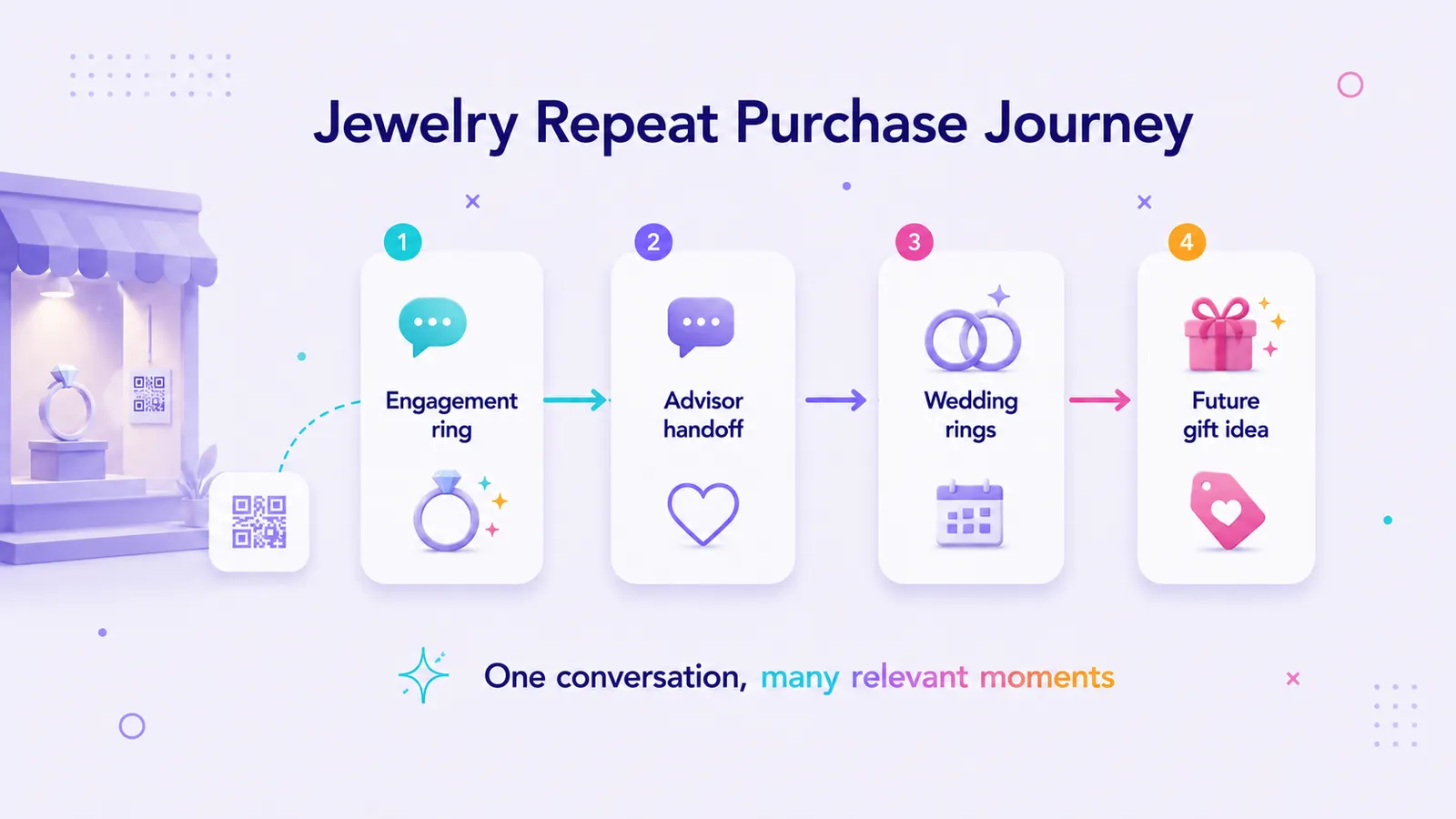
What an Ecommerce Repeat Purchase System Looks Like: A Jewelry Brand Example
An ecommerce repeat purchase system helps a brand bring customers back after the first purchase. For a jewelry brand, that system can start when someone scans a QR code on a store window or clicks a WhatsApp button on the website because they want to buy an engagement ring.
From there, the brand can guide the customer through a mix of automation and human support, help them choose the right ring, recover the sale if they abandon checkout, follow up after the proposal, offer wedding rings, send a wedding gift, create a referral moment for wedding guests, and later recommend a matching piece for Valentine’s Day or an anniversary.
Flownally helps ecommerce brands build these repeat purchase systems across WhatsApp, Instagram, and Messenger, using conversation history, automation, and human handoff when the customer needs real advice.
- Most ecommerce brands have an acquisition system, but not a repeat purchase system.
- This article is a practical jewelry ecommerce example of the repeat purchase system described in our broader guide on increasing repeat purchases in ecommerce.
- Jewelry is a strong example because the purchase is emotional, high-value, and often tied to life events.
- A jewelry repeat purchase journey can start from a QR code, click-to-WhatsApp button, Instagram DM, or Messenger conversation.
- Automation can collect intent, occasion, timeline, budget, and style preferences before handing the customer to a human advisor.
- WhatsApp can support the journey from engagement ring discovery to purchase, abandoned checkout recovery, wedding ring offer, wedding gift, guest referral, and future gift recommendation.
- The strongest system uses automation for predictable steps and human advisors for sensitive, emotional, or high-value decisions.
- Flownally helps ecommerce brands find missed revenue opportunities and turn Meta messaging into repeat purchase journeys.
From repeat purchase strategy to a jewelry example
Repeat purchases rarely occur because of a single campaign. They happen when a brand has a clear system for what happens after the first purchase: post-purchase messaging, support, product education, replenishment, loyalty, and reactivation.
In our guide on how to increase repeat purchases in ecommerce, we explain how this kind of system can improve repeat purchase rate, Customer Lifetime Value, and CAC payback.
This article shows what that looks like in practice.
The example is a jewelry brand, because jewelry is emotional, high-value, and often tied to life events such as engagements, weddings, anniversaries, birthdays, Valentine’s Day, and Christmas.
Why jewelry is a strong example for repeat purchase messaging
Jewelry is not a low-consideration purchase. It’s often personal, expensive, emotional, and tied to a specific moment.
That makes it a good example of why repeat purchase systems need both automation and human support.
The Knot Worldwide’s 2026 Real Weddings Study found that nearly 9 in 10 proposers pop the question with a ring in hand. The same study reported that 61% of engagement rings now feature lab-grown center stones, and that the average engagement ring spend was $4,600.
Rapaport, summarizing The Knot’s 2025 Jewelry and Engagement Study, also reported that 64% of engagement ring purchases were made in-store, while more than half of surveyed consumers said shopping for rings in person was important.
That tells us something major.
Jewelry customers may start digitally, but they still need trust. They may want speed, but they also want reassurance. They may use WhatsApp, Instagram, or Messenger to begin the journey, but they still need a human advisor when the decision becomes emotional, expensive, or personal.
That’s where a messaging journey can help. It gets the right customer to the right advisor with the right context, instead of replacing the advisor.
The example: a customer wants to buy an engagement ring
Imagine a jewelry brand with both an online store and a physical showroom.
A man walks past the store window a few times. He’s planning to propose. He wants to buy an engagement ring, but he doesn’t know where to start.
He doesn’t know:
- how to choose the right stone,
- how to estimate ring size,
- what metal to choose,
- how much to spend,
- what style his partner would like,
- how to make the proposal feel special.
This is an important purchase, but it’s also slightly intimidating. He may not feel ready to walk into the store and speak to a sales advisor face to face.
But there is a QR code on the window:
Choosing jewelry for a special one? Chat with our advisor on WhatsApp.
He scans it. The WhatsApp conversation starts. That small moment is the beginning of the repeat purchase system.
Step 1: Start the conversation from real intent
The first message shouldn’t feel like a generic chatbot. It should recognize the customer’s intent.
Hi, welcome to [Brand Name]. We can help you choose the right piece. What are you looking for today?
- Engagement ring
- Wedding rings
- Gift
- Something else
The customer chooses “Engagement ring.”
Beautiful. I’ll now ask a few quick questions, then connect you with a jewelry advisor who can help you choose the right ring.
The bot is here to collect context, not to pretend to handle the whole decision.
Step 2: Let automation collect the basics
Before a human advisor steps in, automation can ask simple questions.
When are you planning to propose?
- This month
- In 1–3 months
- Later this year
- Not sure yet
Do you already know her ring size?
- Yes
- No
- I need help figuring it out
What style does she usually wear?
- Minimal
- Classic
- Vintage
- Bold
- Not sure
What budget range feels right?
- Under €1,000
- €1,000–€2,500
- €2,500–€5,000
- €5,000+
Now the brand has the right context:
- The customer wants an engagement ring.
- He is not sure about size.
- He has a timeline.
- He has a budget.
- He may need advice.
That is the moment to hand off.
Step 3: Hand off to a human advisor for the emotional decision
Engagement rings should not be treated like a normal product recommendation.
This is a high-value and emotional purchase. Even when the journey starts digitally, the customer may still need confidence, reassurance, and human advice before making a decision.
So the next message should be clear:
Thanks. This is a special purchase, so I’ll connect you with one of our advisors. They’ll help you choose a ring that matches her style, your timeline, and your budget.
Then the advisor enters the conversation.
Hi, I’m Anna from [Brand Name]. I saw you’re looking for an engagement ring and you’re not sure about the size yet. That’s completely normal. I can help you narrow it down. Can I ask what kind of jewelry she usually wears — yellow gold, white gold, silver, or mixed?
This is where the human touch matters.
The advisor can help with:
- ring size,
- proposal timing,
- style,
- budget,
- personalization,
- stone choice,
- whether the customer should visit the store.
Automation opened the conversation, but a person helped with the decision. That balance is what makes the journey work.
Step 4: Recover the customer if checkout is abandoned
Not every customer buys immediately.
He may add a ring to cart and stop. He may need more time or worry about size. He may want to compare options. He may simply get interrupted.
If the customer has opted in to WhatsApp updates, the brand can send a recovery message.
Still thinking about the oval solitaire ring? Choosing the right engagement ring takes time. If you want, our advisor can help you compare it with 2 similar options.
- Show similar rings
- Talk to advisor
- Not now
This is better than a generic abandoned cart message. It respects the decision, gives help and doesn’t pressure the customer with “complete your order now.”
For high-consideration products, the recovery message should reduce uncertainty rather than create urgency for its own sake.
Step 5: Confirm the purchase and keep the customer reassured
Once the customer buys the ring, the post-purchase journey begins.
Your order is confirmed. We’ll prepare your engagement ring and send updates here. If you need help with resizing, delivery timing, or proposal planning, reply HELP.
This message does three things:
- confirms the purchase,
- keeps the customer calm,
- gives a clear route to support.
If the customer replies: “I need it before Saturday.” or “I think I chose the wrong size,” the conversation should go to a person.
Human handoff rule:
Hand off for sizing, engraving, delivery timing, order changes, returns, or anything that affects the proposal.
Step 6: Follow up after the proposal
A few weeks later, the brand sends a message. This should be warm, human, and simple.
Hi [First name], we hope the proposal was a beautiful moment. Did she say yes?
- Yes
- Not yet
If the customer replies “Yes,” the next message shouldn’t jump straight into selling.
Start with the moment.
Congratulations. We’re so happy for you both.
Then continue:
As a thank-you for choosing [Brand Name] for the proposal, we’d love to offer you a special discount on your wedding rings.
- See wedding rings
- Book an appointment
- Talk to an advisor
This is the repeat purchase system in action.
The brand is using context from the first purchase to continue the relationship. And it’s with a message that fits the customer’s life stage, not with a random campaign.
Important note: if your own brand data shows that engagement rings are usually bought by one partner, but wedding rings are often chosen by the couple or the fiancée, this is where the journey should adapt. The next step may invite both partners to participate in the decision.
Many couples prefer choosing wedding rings together. Would you like to book a private consultation for both of you?
That is more thoughtful than sending a generic discount code.
Step 7: Help the couple choose wedding rings
The wedding ring journey can now begin.
Would you like help choosing wedding rings that match the engagement ring?
- Yes
- Show matching styles
- Book appointment
- Ask advisor
If the customer selects “Show matching styles,” automation can suggest categories.
Here are three wedding ring styles that pair well with the ring you chose: classic gold, diamond band, and minimal flat band.
But again, the handoff matters. A human advisor should step in when the couple asks about matching metals, engraving, custom design, sizing, budget, or appointment planning.
Because wedding rings are symbols, not just accessories.
Step 8: Send a wedding gift before the event
A few weeks before the wedding, the brand can send another message. This should feel generous, not transactional.
Your wedding is coming soon. We’d love to send you a small gift from [Brand Name] to celebrate the day.
- Choose delivery address
- Pick up in store
The gift can be small:
- jewelry cleaning cloth,
- small ring dish,
- engraving card,
- care kit,
- handwritten note,
- complimentary ring cleaning appointment.
This message strengthens the relationship. It makes the brand part of the couple’s story and it creates a natural next step.
Step 9: Create a useful gift moment for wedding guests
The same message can include a personalized code the couple can share with guests.
We also created a personal code for your wedding guests: MAYAANDTOM15. They can use it to choose a gift for you from our wedding collection, or to buy a piece of jewelry for themselves.
This works because it is connected to a real event.
Wedding guests are often looking for meaningful gifts, but they may not know what to choose. A personal code gives them a simple place to start.
It can also introduce new customers to the brand in a natural way. Some guests may use the code to buy a gift for the couple. Others may discover a piece they like for themselves. The brand is not just asking for referrals. It creates a useful reason to share.
This is how one purchase can create a wider customer journey around the wedding.
Step 10: Recommend the next gift at the right moment
The journey doesn’t end after the wedding. The next relevant moment may be Valentine’s Day, Christmas, an anniversary, or her birthday.
Valentine’s Day is coming up. The wedding rings you chose were classic yellow gold, so we picked a few pieces that match her style.
- See gift ideas
- Ask advisor
- Remind me later
Looking for a meaningful Christmas gift? Based on the ring style she chose, these pieces may match her everyday jewelry.
This message works because it has context.
It’s not saying: “New collection live.”
It’s saying:
We remember the style you chose, and we can help you choose something that fits.
That is what turns messaging into retention.
The full repeat purchase journey
In this example, the jewelry brand doesn’t win only one sale. It creates a connected journey:
- 1QR code or click-to-WhatsApp
- 2engagement ring discovery
- 3bot qualification
- 4human advisor
- 5purchase
- 6abandoned checkout recovery
- 7proposal follow-up
- 8wedding ring offer
- 9wedding gift
- 10guest referral code
- 11holiday gift recommendation
That is the difference between a campaign and a repeat purchase system: a campaign sends one message, a system connects the next relevant moment.
Why this journey works
This jewelry journey works because every message has a reason:
- The QR code starts with real intent.
- The bot collects simple information.
- The human advisor handles the emotional decision.
- The abandoned checkout message offers help instead of pressure.
- The post-proposal message matches the customer’s life moment.
- The wedding ring offer is relevant.
- The wedding gift feels personal.
- The guest code creates a referral loop.
- The holiday recommendation creates the next repeat purchase moment.
Why messaging channels and compliance matter
Many jewelry journeys already start in messaging channels. A customer may ask about ring size on Instagram, send a WhatsApp message about delivery timing, or reply on Messenger after seeing a gift collection.
These conversations contain buying intent and customer context. If they are handled separately, that context gets lost. If they are organized in one system, they can become part of a repeat purchase journey.
That is why WhatsApp, Instagram, and Messenger are not only support channels. They can help a jewelry brand guide the first purchase, follow up after the proposal, offer wedding rings, send a useful guest code, and recommend future gifts.
The important part is that outbound messages should be permission-based and compliant with WhatsApp rules. Proposal follow-ups, wedding ring offers, guest codes, and holiday recommendations should be expected, relevant, and properly templated where required.
Where automation should stop
This journey should not be fully automated.
Automation is useful for:
- starting the WhatsApp conversation,
- collecting basic preferences,
- sending reminders,
- recovering abandoned checkout,
- confirming the order,
- sending post-purchase updates,
- asking quick-reply questions,
- triggering wedding or holiday follow-ups.
A person should step in when:
- the customer is choosing the engagement ring,
- the customer needs emotional reassurance,
- sizing is uncertain,
- delivery timing is urgent,
- the product is high-value,
- engraving or customization is involved,
- the customer asks for advice,
- the message affects trust.
Salesforce’s State of the AI Connected Customer reports that 72% of customers say it is important to know if they are communicating with an AI agent. That is a useful reminder that automation should be clear, helpful, and easy to leave, but it shouldn’t pretend to be a person.
The human touch isn’t writing every message manually. But it is knowing when the customer needs a real advisor.
What this means for ecommerce brands
This example is about jewelry, but the same logic applies to many ecommerce categories.
- A beauty brand can build a routine journey.
- A supplement brand can build a replenishment journey.
- A fashion brand can build an event-based styling journey.
- A baby products brand can build a stage-based lifecycle journey.
- A pet brand can build reorder and care reminders.
The category changes, but the system stays the same.
- Start with a high-intent customer moment.
- Use automation to collect context and handle predictable steps.
- Use a person when the decision needs care.
- Follow up based on what actually happened.
- Bring the customer back with relevance, not noise.
How Flownally helps build journeys like this
Flownally helps ecommerce brands increase repeat purchases and customer retention through Meta Business Messaging.
We start with a free messaging strategy review.
Together, we look for:
- missed revenue opportunities on WhatsApp, Instagram, and Messenger,
- customer journey gaps before and after purchase,
- conversations that should trigger follow-up,
- abandoned checkout recovery opportunities,
- retention and reactivation flows,
- post-purchase messaging campaigns,
- automation opportunities that improve customer experience,
- moments where a person should step in.
Once the strategy is clear, Flownally helps implement the system.
That can include:
- WhatsApp, Instagram, and Messenger chatbots,
- customer journey automation,
- retention and re-engagement flows,
- post-purchase messaging campaigns,
- abandoned checkout recovery,
- product recommendation flows,
- lead qualification,
- customer support automation,
- human handoff rules,
- shared inbox workflows.
What makes the approach different is simple. We don’t start by asking, “What chatbot should we build?”
We start by asking:
Where is the customer journey leaking revenue?
Then we build the messaging system around that.
Most ecommerce brands already have a system for acquisition. But they still need a system for bringing customers back.
Flownally helps ecommerce brands turn WhatsApp, Instagram, and Messenger conversations into repeat purchase journeys. Not more noise or generic blasts, but a clear messaging system that helps customers move from first intent to first purchase, and from first purchase to the next one.

FAQ
An ecommerce repeat purchase system is a connected set of messages, automations, human handoff rules, and customer journeys that helps customers buy again after their first purchase.
A jewelry brand can increase repeat purchases by turning engagement ring, wedding ring, gifting, anniversary, and holiday moments into connected messaging journeys. The brand can use WhatsApp to guide product choice, recover abandoned checkout, follow up after the proposal, offer wedding rings, send a wedding gift, create referral moments, and recommend future gifts.
WhatsApp is useful because jewelry purchases often involve questions, emotion, trust, and timing. Customers can ask for advice, receive product recommendations, get delivery updates, and talk to a human advisor when the decision is important.
Not fully. Automation can collect basic information such as occasion, timeline, budget, style, and ring size. But a human advisor should step in when the customer needs personal advice, reassurance, sizing help, or support with a high-value purchase.
A jewelry brand can send order updates, delivery messages, sizing support, proposal follow-ups, wedding ring offers, appointment reminders, care tips, wedding gift messages, guest referral codes, and holiday gift recommendations, as long as the customer has opted in and messages follow WhatsApp rules.
Instead of sending a generic discount, the brand can send a helpful message based on the product viewed or added to cart. For example: “Still thinking about the oval solitaire ring? Our advisor can help you compare it with two similar options.”
Keep messages short, useful, and tied to the customer’s real context. Be clear when automation is used, and make it easy to reach a person. For emotional or high-value decisions, use automation to support the advisor, not replace them.
Human handoff matters because jewelry purchases often involve emotion, budget, sizing, timing, personalization, and trust. Automation can collect context, but a human advisor should handle the moments where the customer needs judgment or reassurance.
Yes. The same logic works for beauty, supplements, fashion, home products, baby products, pet products, and other ecommerce categories. The key is to connect the first customer intent with post-purchase support, follow-up, reactivation, and the next relevant purchase moment.
Flownally helps ecommerce brands design and automate messaging journeys across WhatsApp, Instagram, and Messenger. It helps teams capture intent, automate predictable steps, create follow-ups, recover abandoned checkout, manage customer conversations, and hand off to a person when needed.
During a messaging strategy review, Flownally helps identify missed revenue opportunities, customer journey gaps, follow-up opportunities, abandoned checkout recovery ideas, retention flows, reactivation moments, and automation opportunities across WhatsApp, Instagram, and Messenger.
Yes. Instagram DMs and Messenger can capture product questions, gift intent, sizing questions, appointment requests, and follow-ups after a customer sees a collection or campaign. When these conversations are connected with WhatsApp and managed in one place, they can become part of the same repeat purchase journey.